What Recruiters Actually Want From Data Scientists in 2025
Let’s be real—data science is not the shiny, new thing it used to be. It has grown up now. Every company is knee-deep in data, and just knowing a bit of Python or slapping together a model is not going to cut it anymore. If you are trying to get into data science—or stay in it—you need to understand what recruiters are actually looking for as we head into 2025.
And spoiler: it’s not just about technical chops anymore. Sure, those matter. But the bar has moved. A lot.
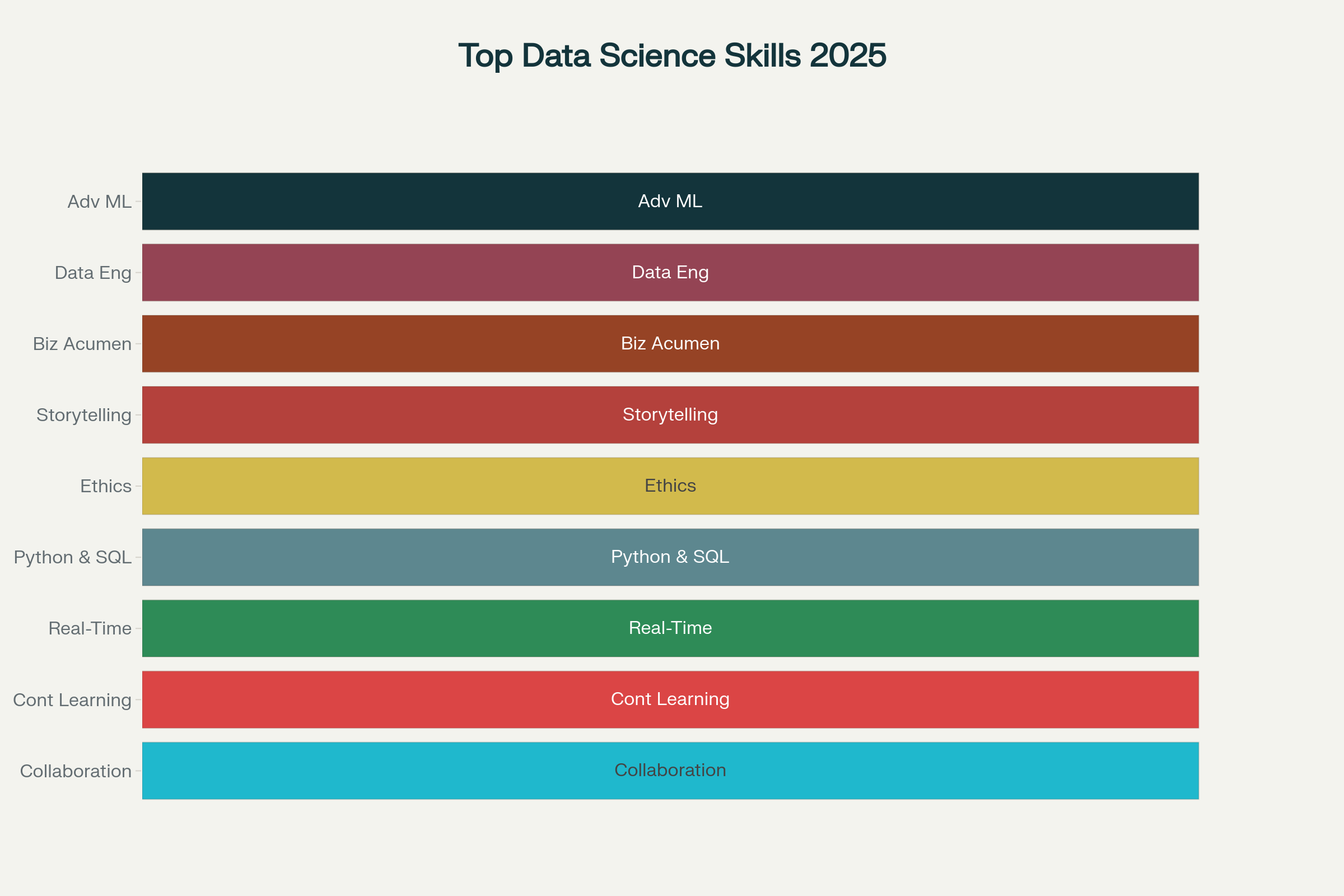
Advanced Machine Learning Is the Baseline Now
This might sound a little harsh, but just knowing linear regression or scikit-learn is not impressive anymore. Everyone knows that stuff now. If you want to stand out in 2025, you really need to go deeper.
We are talking transformers, reinforcement learning, diffusion models, multimodal AI—basically the stuff behind ChatGPT, Stable Diffusion, all that. If you have played around with Hugging Face or fine-tuned something using OpenAI’s APIs, that is solid. But just using these tools is not enough. Recruiters want to know you actually understand them. Like, can you explain what is going on under the hood? Can you debug when something breaks? Can you explain why a model is making weird predictions?
Oh, and it helps a lot if you can talk about the ethical side of this stuff, too. People are finally realizing that “cool AI demo” does not mean “responsible AI system.”
You Cannot Ignore Data Engineering Anymore
Here is the thing: you could be the smartest ML person in the room, but if you cannot get the data into your model cleanly—or work with engineers who do—you are going to hit a wall. More and more teams are merging data science with data engineering. You should be at least comfortable with things like Airflow, Docker, Kubernetes, and cloud stuff (AWS, GCP, Azure—you know the drill). MLOps is not just a buzzword anymore; it is part of the job. You need to know how to build a pipeline that does not fall apart in production.
To be honest, if you cannot take a model from a Jupyter notebook to a real-world deployment, that is going to be a red flag for a lot of recruiters.
Knowing the Business Actually Matters
You might be wondering, “Isn’t my job just to build models?” Technically, yes—but not really. Here’s what recruiters are actually looking for: someone who can translate messy business problems into something solvable with data. And then explain the solution back in plain English.
So yeah, if you are working in healthcare, learn the basics of how insurance billing works. If it is retail, understand inventory, pricing, customer churn. Context matters. It is not about being a domain expert overnight, but you have to show you care enough to learn how your models impact the real world.
Storytelling > Fancy Charts
A good model is useless if nobody understands it. And honestly, a lot of people suck at explaining their results. You need to be the kind of person who can walk into a room with execs, explain what your model does without using words like “R-squared” or “gradient descent,” and still make them care. That takes practice. It also takes empathy—knowing what your audience actually needs from the data.
This does not mean you need to become a full-time data viz designer, but you should be able to build a chart that tells a clear story. Tableau, Power BI, Plotly—sure, those tools help. But the tools are not the hard part. The hard part is knowing what to show, and how to talk about it without overwhelming people.
Ethics Are Not Optional Anymore
Look, the AI space is moving fast—and not always in the right direction. Privacy, bias, explainability… these are not niche concerns anymore. If you build a model that accidentally discriminates against people, it is not just a technical issue. It is a legal and reputational disaster. Recruiters are being way more careful about this stuff now. Especially in industries like finance or healthcare, where a bad prediction can seriously mess up someone’s life.
You do not have to be an ethics researcher. But you do need to show that you think about these things. Mention them in interviews. Talk about fairness, auditability, regulatory stuff like GDPR or HIPAA. It shows maturity—and it shows you are not just in it for the tech flex.
Python Still Reigns… But It Is Not Alone
Let’s keep this simple: if you are not good at Python by now, you have got a problem. It is table stakes. But that is not all. SQL is still the backbone of data work. And if you can use R for statistical stuff, or Julia for high-performance needs, that is a bonus. Also, Git is not optional anymore. You should know how to collaborate using GitHub or GitLab, not just code in a vacuum.
Write clean code. Comment it. Organize your files. These sound boring, but trust me, people notice.
Real-Time Data Is Becoming the Norm
A lot of companies are moving away from static dashboards. They want real-time alerts, streaming insights, and models that can update on the fly. This is especially true in stuff like fraud detection, recommendation engines, and supply chain management. So yeah, if you can work with Kafka, Spark Streaming, or Flink, that is a big plus. And you should know how to work with large datasets that do not fit on your laptop. Think distributed computing, parallel processing—the heavy-duty stuff.
This is where knowing your way around cloud environments really pays off.
You Have To Keep Learning. No Way Around It.
Honestly, data science moves fast. What was “hot” two years ago might be irrelevant now. If you are not the kind of person who keeps up with new papers, tests new libraries, or follows industry chatter, it is going to show. Recruiters love people who are curious. If you have a side project, a Kaggle notebook, a GitHub repo with experiments—that stuff counts. It tells them you are not just coasting.
It is not about being an expert in everything. It is about showing you want to keep improving, and that you are not stuck in 2018.
You Cannot Do This Alone
One last thing: the lone-genius data scientist is a myth. Most projects now involve product folks, engineers, UX designers, domain experts—you name it. If you cannot work on a team, take feedback without getting defensive, and collaborate like an adult, it is going to be a tough ride.
Agile is everywhere. Meetings happen. Slack threads never die. You need to be part of the conversation, not just someone who pops in with a Jupyter notebook and bounces.
Wrapping It Up
So yeah, being a good data scientist in 2025 is not just about the math or the code. It is about being someone who can bridge the gap between raw data and real-world impact. You need the technical skills. No question. But if you can also communicate, think strategically, act responsibly, and stay adaptable—those are the things that really make recruiters pay attention.
And if you are just getting started, do not panic. Pick a few areas here to focus on. Build stuff. Share it. Learn in public. That is the best way to stand out.
Check Our Courses : Data Science Classroom Training, Data Science Training Course in Bangalore, Python Classroom Training.