Machine learning is not just sitting in research papers anymore. In India, it is already doing real work — and not just in fancy labs or big companies. It is showing up in farms, hospitals, classrooms, traffic systems, and even in your UPI app. That sounds like a lot, and it is. But let me explain it one by one, in plain language.
This is not a list of AI dreams. These are things already happening, and some of them might surprise you.
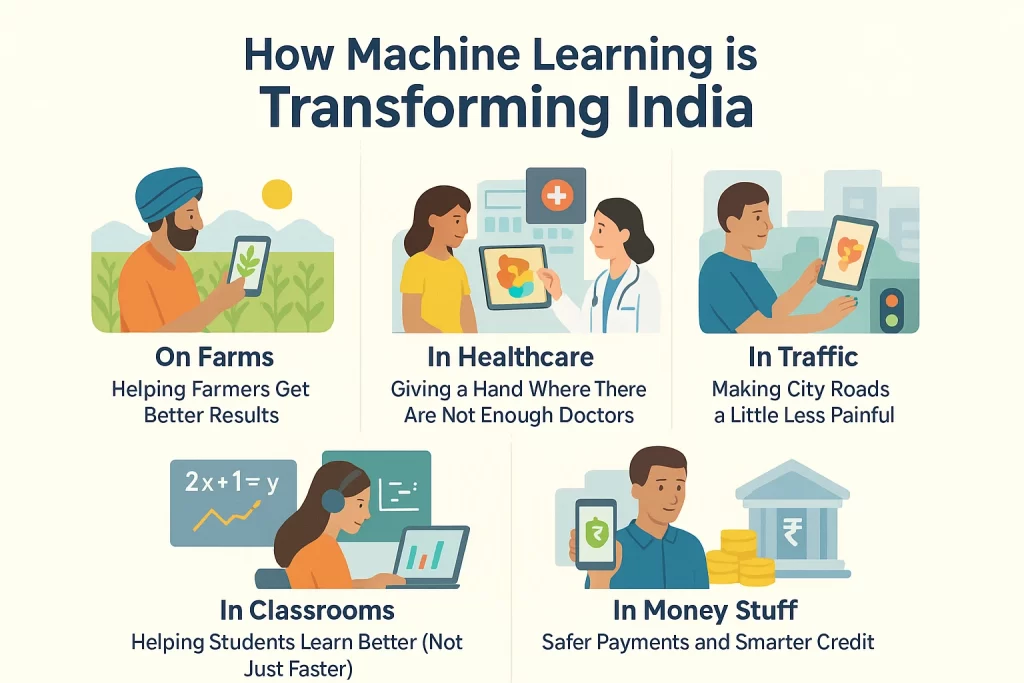
🌾 On Farms: Helping Farmers Get Better Results
India depends a lot on farming. But farming here is not easy. Weather is confusing, pests come out of nowhere, and prices in the market change too much. But machine learning is slowly stepping in to help.
There are apps now where a farmer can click a photo of a plant, and it tells what disease the plant has. Apps like Plantix are doing that. They are not perfect, but they work most of the time.
Some platforms are using satellite images and sensors to give farmers info on when to plant and when to water.
Companies like CropIn are helping with this too. It is all very technical under the hood, but for the farmer, it feels simple. They get alerts and tips, and that helps avoid losses.
🏥 In Healthcare: Giving a Hand Where There Are Not Enough Doctors
India has way more patients than doctors, especially in villages. Machine learning is not replacing doctors, but it is helping them do more with less.
One example is Niramai. It uses thermal imaging and ML to detect early signs of breast cancer. No big machines, no painful tests. Just heat maps and algorithms. It is being used in camps where hospitals are far away.
Also, apps like Practo and mfine have ML chatbots. You type your symptoms, and they suggest what to do. It is not as good as a real doctor, of course, but it helps in areas where people wait days for appointments.
Even hospitals are using machine learning now to guess when they will get more patients or where beds might fall short. That really helped during the COVID-19 waves.
🚦 In Traffic: Making City Roads a Little Less Painful
If you have lived in a city like Bengaluru, you know what I am talking about. Traffic is a daily headache. But machine learning is quietly helping behind the scenes.
Google Maps India, for example, uses real-time data to predict traffic and give faster routes. It is not magic — it is ML trained on GPS data from thousands of users.
Smart traffic lights are also becoming a thing in a few cities. They change signals based on how many vehicles are waiting. It is not perfect yet, but better than fixed-timer red lights.
And then there is Ola and Uber. Their apps use ML to match you with drivers, decide pricing, and even guess if a trip might get delayed. Most people do not realize how much machine learning is working in the background there.
📚 In Classrooms: Helping Students Learn Better (Not Just Faster)
There are over 250 million students in India. No way can one-size teaching work for everyone. That is where ML is helping.
Apps like BYJU’S and Unacademy use ML to adjust learning paths. If you are weak in math but strong in science, it will show you more math practice. It watches how you answer, how much time you take, and even when you give up. Then it reshapes the next session for you.
There are even tools now that can grade essays using ML. Teachers get more time to actually teach instead of just marking papers.
Also, language tools powered by AI are letting students in rural areas learn in their mother tongue. That is a big deal because many dropouts happen simply because students cannot follow English content.
🏦 In Money Stuff: Safer Payments and Smarter Credit
India is moving fast toward digital payments. With that comes fraud, and that is where machine learning is now part of the fight.
Apps like PhonePe, Google Pay, and Paytm use ML to detect suspicious activity. If someone tries to send a lot of money from a strange location or new device, it might flag or block it.
Also, some startups are using ML to give loans to people who have no formal credit score. They check mobile usage, SMS patterns, even app usage. It sounds a bit creepy, but it actually helps people who banks usually ignore.
Banks also use ML for customer support — those chatbots that answer your balance query? That is machine learning too.
🏛 Government Stuff: Yes, Even They Are Using It
The Indian government is also using machine learning, though not always perfectly. The Meteorological Department now uses ML to make monsoon predictions more accurate. That helps with farming and disaster planning.
In cities like Hyderabad, ML is used in predictive policing — trying to find crime hotspots before something happens. It is still new, and obviously there are privacy worries, but it is being tested.
The Aadhaar system also uses machine learning to stop duplicate entries and detect fraud using face or fingerprint mismatches.
🧠 Final Thoughts: Real Impact, Not Just Tech Talk
Machine learning in India is no longer just a fancy tech trend. It is helping in real ways — especially in places where humans alone cannot keep up.
No, it is not perfect. There are still problems with internet in rural areas, privacy issues, and a lack of trained people. But the direction is clear: more people are using ML tools without even realizing it.
If you are someone who wants to learn ML, there are problems to solve all around you. In India, you do not need to look far to find a use case that actually matters.
Check Our Courses : Machine Learning Course , Deep Learning Course , Machine Learning Training With Python , AI-Deep Learning using TensorFlow , AI Full Stack Online Course .