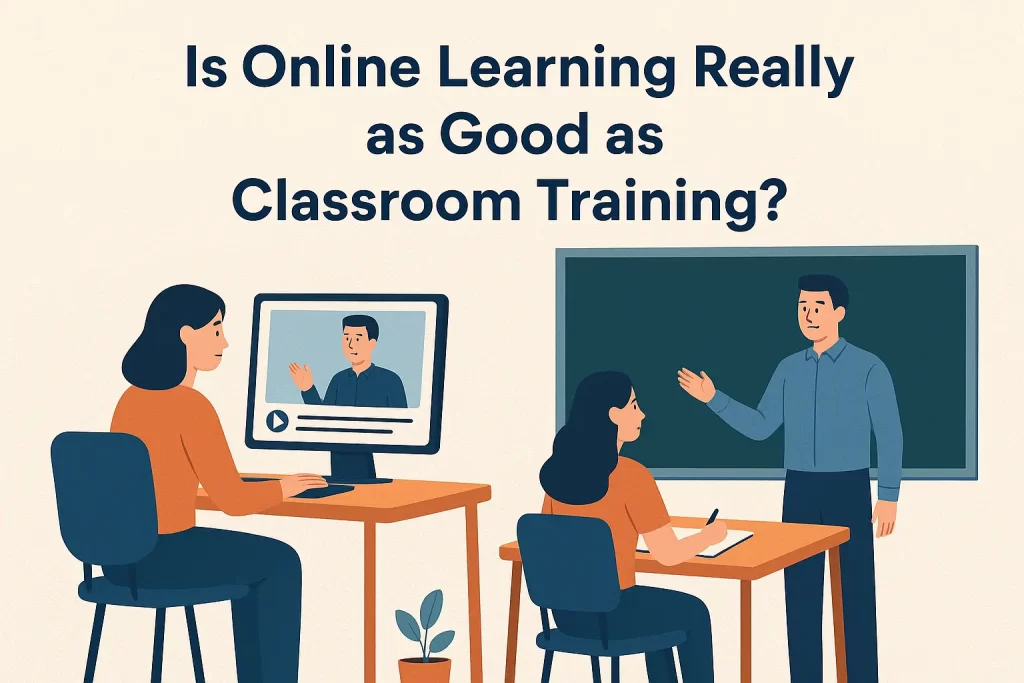
For decades, school and learning looked pretty much the same everywhere. A classroom, a teacher scribbling on the board, rows of students half paying attention. That picture is so baked into our idea of “education” that when online classes started taking off, a lot of people thought: wait, can staring at a laptop really replace the vibe of a classroom?
Fast forward to 2025, and this question is no longer hypothetical. Kids are doing hybrid school schedules, college students are attending lectures from their dorms or even their bedrooms, and professionals are finishing full degrees online without ever stepping into a lecture hall. The big question still hangs, though: is online learning actually as effective as sitting in a classroom?
The frustrating answer: it depends.
Why Classrooms Still Have Magic
Let’s be honest—there is something special about a real classroom. You are not just listening to a teacher; you are soaking up the whole energy of being around other students. Group projects, quick debates, the kind of spontaneous discussions that happen when someone blurts out a question—those are hard to recreate online.
Think about a high school science class. The teacher sets up a mini experiment, everyone gathers around, and the chatter spreads across the room. That shared memory sticks in a way that a YouTube video never will.
Parents also like classrooms because they come with built-in structure. There’s a bell schedule, a teacher keeping an eye on who’s zoning out, and fewer distractions than you would get at home. Plus, teachers can read the room—if a student looks confused, stressed, or bored, they’ll usually notice. Try spotting that when everyone’s tiny square is muted on Zoom.
And for younger kids especially, the classroom is about way more than academics. Walking to class with friends, working on group projects, even the awkward lunchroom stuff—it all shapes social skills.
The Strengths of Online Learning
That said, online learning is not just a second-rate backup anymore. It has some clear strengths that explain why it has gone mainstream.
The obvious one is flexibility. A professional in Mumbai can finish work, grab dinner, and then log into a data science course taught by MIT professors. A student in a small town can join a coding bootcamp without having to move to a big city. You are not locked down by geography or strict timetables.
Another perk is personalization. In a classroom, the pace is set by the teacher. Some students fly ahead, others get lost. Online, you can pause, rewind, or replay until it makes sense. Many platforms even adapt to you—serving up extra exercises in areas where you struggle, which feels a bit like one-on-one tutoring.
And resources? Endless. A single platform can connect you to global lecture libraries, practice quizzes, forums full of peers, and guest experts you’d never have access to in a regular classroom.
What Studies Actually Say
A lot of people assume there’s a clear winner here, but research paints a more nuanced picture. Over the past decade, study after study has shown that when online programs are well-designed, students perform just as well as they do in classrooms—and in some cases, even better.
For example, a U.S. Department of Education study found that students in blended setups (where you mix online modules with in-person classes) often outperform students who only attend traditional classrooms. The reasoning makes sense: online tools let you repeat and reinforce material, while in-person sessions bring the human connection.
But here’s the catch: effectiveness depends on engagement. If a student just passively watches videos, they usually do poorly. If they participate in discussions, submit projects, and interact with the material, results improve drastically. In other words, the medium is not magic. It’s about how you use it.
The Struggles of Online Learning
Of course, online learning has its downsides, and they are worth being upfront about.
Studying from home means distractions are everywhere—social media, roommates, kids, or just the temptation to nap. Without the structure of a classroom, self-discipline becomes critical, and not everyone is wired for that.
Isolation is another big one. Some students really miss the buzz of human interaction. Motivation can take a hit when you don’t have peers sitting next to you or a teacher walking around checking in.
And then there’s the very practical issue: reliable internet, a quiet space, and working devices are not a given for everyone. That digital divide is real.
Blended Learning: A Middle Ground
This is why many educators and professionals believe the future is blended learning—taking the best of both worlds.
Imagine a physics student who learns theory online with interactive modules, complete with animations and quizzes, then goes into class to actually run the experiments and debate the results. Or a professional who watches lectures during the week and attends hands-on workshops on weekends.
Online gives the flexibility and repetition. In-person keeps the social and collaborative element alive. Together, they cover each other’s weaknesses.
The Human Factor
Here’s the thing: no matter how slick the technology, learning is still a human process. A passionate teacher can make even a dry subject engaging, whether it’s online or offline. A disengaged teacher can bore you to tears on any platform.
Same goes for students. Motivation plays a bigger role than the medium itself. A driven learner will thrive online or in a classroom. Someone who is checked out will probably struggle in both.
That is why the question parents often ask—“which is better, classroom or online?”—is a bit off. A smarter question is: “which setup fits this student’s learning style?” Some kids need the structure and energy of being around peers. Others do better with the flexibility of learning at their own pace.
Advice for Students
If you are a student thinking about online learning, do not assume it will be easier. In some ways, it can be harder. You need to create your own routines, participate actively, and reach out when you get stuck. Freedom is great, but it also means you are responsible for how you use it.
Advice for Parents
If you are a parent, try not to think of online learning as replacing the classroom. Think of it as an extension of it. Support your child by helping reduce distractions, setting routines, and encouraging them to treat online classes with the same seriousness as in-person ones. Both routes can work—it depends how they are managed.
Wrapping It Up
So, is online learning as effective as classroom training? The honest answer: it can be, but only if it is done right.
Classrooms bring structure, human interaction, and real moments. Online learning brings flexibility, personalization, and global access. Neither is perfect, but together, they can complement each other.
At the end of the day, what really matters is not the format but the mindset. Curiosity, discipline, and the willingness to keep learning will carry you further than any platform.
Whether you are a student prepping for college, a professional upgrading your skills, or a parent guiding your kid, remember this: learning is no longer tied to four walls. It can happen in a classroom, on your couch, or even on a train ride with just your phone. What counts is not where you study, but how you show up.
Check Our Courses : Data Science Classroom Training, Machine Learning Course, Deep Learning Course , Deep Learning Course , AI Full Stack Online Course, Core Ai classroom training, Cyber Security Course .