By the Nearlearn Team | Published: October 28, 2025
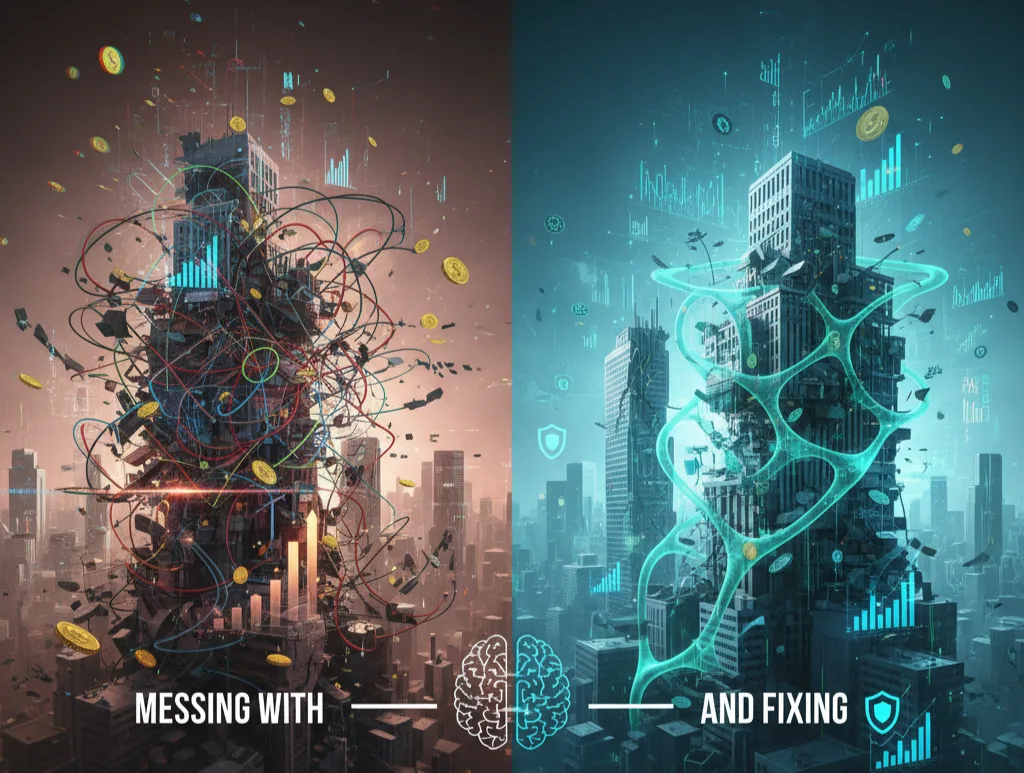
Okay, so let’s talk about machine learning and finance. You’ve probably heard people throw those words around like they are some kind of magic spell — “AI this, data that.” But what’s actually happening is kind of wild.
Banks, trading firms, fintech startups — basically everyone — are using machine learning to do things faster, cheaper, and smarter than before. Fraud gets caught in seconds, trades happen in microseconds, and credit decisions that used to take days now happen instantly.
It is not perfect. Some of it is messy. But it is definitely changing how money works.
So let’s break this down in a way that actually makes sense.
What Machine Learning Even Means (in Simple Terms)
At its core, machine learning (ML) is just a fancy way of saying: computers are getting better at figuring things out on their own.
In the past, programmers had to spell out every single rule. Like, “if a payment is over $10,000 and from a new account, flag it.” Now, with ML, you feed a model tons of real data — say, millions of transactions — and it starts noticing patterns by itself.
It’s kind of like teaching a junior analyst who learns from experience, except this one doesn’t sleep, doesn’t complain, and can go through a year’s worth of data in seconds.
In finance, that’s a huge deal. There’s just too much data for humans to process anymore. We’re talking millions of trades, market updates, customer actions, and news events every single day. ML eats that stuff up and turns it into insights, predictions, or automated actions.
Fraud Detection That Never Sleeps
This might be the most obvious use case, and honestly, it’s one of the coolest.
Banks lose billions every year to fraud. Old systems used to rely on simple rules, but fraudsters caught onto those fast. Machine learning changed the game.
Now these models track hundreds of variables at once — time of day, location, device used, past transaction history — and when something looks off, it raises a flag instantly.
You know when your bank sends that text, “Was this you?” right after a weird charge? That’s ML doing its thing behind the scenes.
PayPal and Visa are deep into this stuff. Visa’s models apparently check over 500 attributes per transaction — which is nuts — and they claim it helps prevent over $25 billion in fraud losses each year.
The best part is these models keep learning. So when scammers try new tricks, the system eventually picks up on them automatically. It’s like having an anti-fraud immune system that evolves.
Rethinking Credit Scores (Because They’re Kind of Broken)
If you’ve ever been frustrated with your credit score, you are not alone. Traditional credit scoring is super narrow — it mostly looks at past loans, repayment history, and a few other basics.
Machine learning is fixing that by pulling in “alternative data.” Things like rent payments, phone bills, job history, or even your online spending habits.
I know that sounds creepy, but stay with me — it actually helps people who normally get ignored by the system. Like students, freelancers, or new immigrants who don’t have years of credit history.
ML models can see the full picture and say, “Hey, this person is financially responsible even if they don’t have a traditional credit file.” That means fairer lending, fewer rejections, and honestly, a better shot at financial inclusion for a lot of people.
Trading That Happens Faster Than You Can Blink
This part’s straight out of sci-fi.
Machine learning has completely taken over algorithmic and high-frequency trading. Computers now make decisions based on real-time market data, global news, and even social media sentiment.
These systems don’t just follow pre-programmed strategies — they learn what works and adjust automatically. Some are trading thousands of times per second, trying to take advantage of tiny price differences that only last milliseconds.
It’s crazy.
Now, to be fair, it’s also controversial. When trades happen faster than humans can react, small bugs can cause big chaos. But firms are starting to adopt frameworks like SAFE (which stands for Sustainability, Accuracy, Fairness, and Explainability) to make sure their trading models are not black boxes of doom.
Robo-Advisors: Investing Without the Fancy Suits
If you’ve used something like Vanguard Digital Advisor, Betterment, or Schwab’s robo-advisor, you’ve already seen machine learning in action.
Here’s how it works: you answer a few questions about your goals, your risk tolerance, maybe your retirement timeline. The system then builds a portfolio for you, monitors it automatically, and rebalances when markets shift.
It’s not perfect, but for regular investors who do not want to pay a human advisor thousands in fees, it’s a great deal.
The cool thing is these systems are starting to blend automation with human advice. So if you need real help, there’s still someone you can talk to. But the heavy lifting — the math, the rebalancing, the monitoring — that’s all ML now.
Chatbots That Actually Understand You (Mostly)
Let’s be real: dealing with customer service in banking used to be painful. You’d call, wait on hold forever, get transferred five times, and still not have your issue fixed.
Now, ML-powered chatbots are changing that.
They use something called Natural Language Processing (NLP), which basically means they can understand your messages instead of just responding to keywords. So you can type “Hey, I think someone charged me twice” and it’ll know what you mean.
Sure, they still get confused sometimes, but they’re improving fast. And when they can’t handle it, they pass you to a human agent without all the “press 3 for support” nonsense.
The Compliance Beast
Banks have to follow endless regulations — anti-money laundering (AML), KYC, GDPR, you name it. Keeping up manually is a nightmare.
ML helps by scanning every transaction for suspicious behavior, compiling reports automatically, and even predicting where compliance risks might appear.
It’s not sexy work, but it’s a lifesaver for financial institutions trying to avoid million-dollar fines.
Why Everyone’s Betting on ML
So yeah, ML is making finance faster, cheaper, more accurate, and honestly, more fair — when it’s done right.
It can analyze oceans of data in seconds, automate repetitive stuff, and personalize services like never before. That’s why every major player in finance is diving into it.
But here’s the thing…
It’s also tricky.
ML needs tons of clean data, and that’s easier said than done. Some models are basically black boxes, which regulators hate. Bias is a big issue too — if the data is biased, the outcomes will be biased.
And implementing ML isn’t cheap. You need data scientists, engineers, and often a full system overhaul. For smaller banks, that’s a big hurdle.
What’s Coming Next
If you think ML has already peaked, you’re wrong. It’s just getting started.
There’s talk of “agentic AI,” which basically means AI systems that can make independent financial decisions (within guardrails, of course).
Generative AI — like the tech behind large language models — is now being used to write reports, simulate markets, and analyze regulatory documents automatically.
And quantum machine learning is somewhere on the horizon. That’s next-level stuff — solving problems in portfolio optimization that normal computers can’t even touch.
Personalization will keep improving too. Your banking app might soon act like a financial coach that understands your habits, lifestyle, and goals better than you do.
The Bottom Line
Machine learning isn’t some future thing we’re waiting for — it’s already baked into the way modern finance works.
It’s helping banks spot fraud before it happens, letting everyday people invest smarter, and making financial systems more efficient overall.
But like any powerful tool, it comes with trade-offs. You’ve got to use it responsibly, test it constantly, and make sure you understand what’s happening under the hood.
If you’re in finance — or just curious about where your money world is heading — start paying attention now. Because the companies figuring this out? They’re going to be the ones leading the next decade of finance.
Check Our Courses : Data Science Classroom Training, Python Classroom Training, Machine Learning Course , Deep Learning Course , AI-Deep Learning using TensorFlow , AI Full Stack Online Course , Cyber Security Course in Bangalore , Core Ai Training , Digital Marketing Training , Power BI Training in Bangalore , React Js Training , Devops Training in Bengalore , Microsoft sql Training .