Okay, quick truth
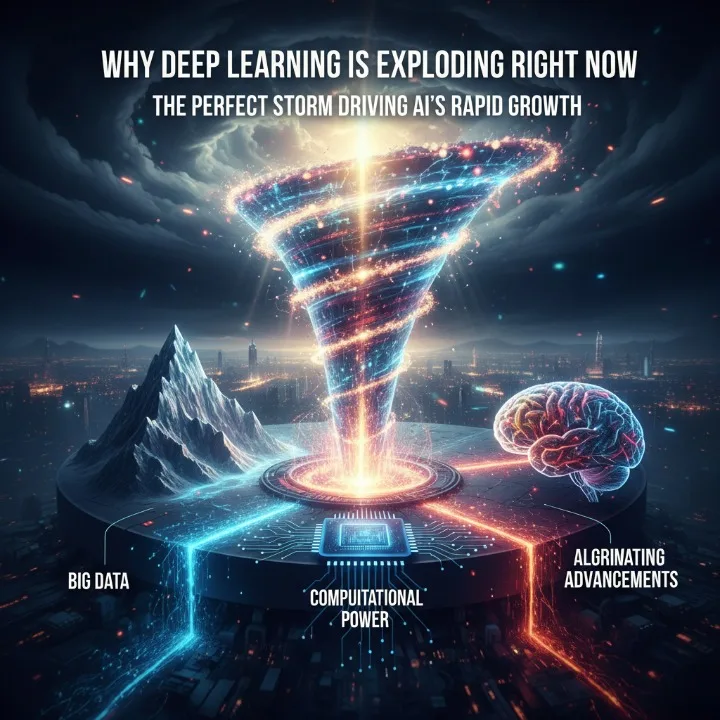
deep learning did not blow up because of one flashy paper or a single genius moment. It exploded because a lot of messy, useful things all happened to line up at the same time. Data. Cheap and fast chips. Cloud servers everyone can rent. Smarter architectures like Transformers. Tons of money. And a few public moments that made the whole thing click for regular people. I will try to walk through that without making it sound like a corporate press release.
Numbers that actually mean something
If you like big numbers, here is one that will make you blink. The deep learning market was around $72 billion in 2023 and analysts say it could be close to $858 billion by 2032. Those are not tiny changes. And generative AI — one slice of the deep learning pie — is projected to go from tens of billions to trillions in value over the next decade. Wild, I know.
But those figures are not just fantasies. They reflect real bets companies are making because the tech is starting to pay for itself. People are not investing for fun. They are investing because AI is saving time, cutting costs, or enabling new products that would not exist otherwise.
Data: the thing models actually want
You have probably heard that “data is the new oil.” It is trite, but it is not wrong. The world is creating mountains of data — phones, cameras, sensors, apps, enterprise systems. By the mid-2020s we are talking about hundreds of zettabytes. That word sounds silly, but the point is: there is a lot of signal to feed models now.
Here is the practical bit. Traditional machine learning often hits a performance plateau. Deep learning does not stop as fast. Give it more examples and it usually gets better. So more data means better models, which means more useful apps, which means more data again. The loop feeds itself. That is how you get exponential change instead of linear.
Hardware finally stopped holding things back
Remember when training a decent model took weeks or months on a CPU? That era is mostly over. GPUs — originally for games — turned into the workhorses for neural nets because they can do a lot of maths in parallel. A modern GPU can crush a CPU for training tasks. And then companies built special chips — TPUs, custom ASICs, neuromorphic stuff — designed for specific AI workloads. Those chips are not just iteratively better, they unlock whole new classes of models that were impractical before.
So the simple story is this: models got bigger and more ambitious, and then hardware showed up to keep pace.
Cloud made access democratic
Here is one underrated point: you do not need to own a data center anymore. Cloud providers let you rent the same compute power that used to cost millions to buy and maintain. That matters more than it sounds. A small team can prototype a model in days. A solo dev in a country with fewer resources can test ideas that would otherwise require impossible budgets.
That shift — from CapEx to OpEx — is huge. It flattened the playing field. That is one reason innovation came from unexpected places, not just the top labs.
A few watershed moments changed mindsets
If you like milestone stories, there are a couple. AlexNet in 2012 was a wake-up call. It beat everyone at ImageNet and showed that deeper networks trained on GPUs actually worked better on big, messy vision tasks. It was the sort of result that makes funders and labs pay attention.
Fast forward to 2017 and Transformers. That architecture let models focus on relevant parts of input with attention mechanisms. It handled long-range dependencies in language and scaled well. Suddenly, everything from translation to creative writing looked doable. Then ChatGPT arrived in 2022 and made AI feel immediate and personal for millions. From a research topic to something you chat with on your phone — that shift changed public perception overnight.
Money follows what works
Investors noticed. When tools go from niche to usable, capital floods in. Venture rounds balloon. Big players buy startups or build in-house capabilities. That money does a few things: it pays for more compute, it hires talent, and it pushes productization — turning research into real software people use. That commercial pressure also accelerates improvements, for better and worse.
Real-world wins, not just flashy demos
This is important: deep learning is not only about clever demos. It is already reshaping industries. In healthcare, models assist with imaging and diagnostics. In automotive, perception stacks for autonomy use deep nets to interpret complex scenes. Finance uses models for fraud detection and risk signals. Manufacturing uses predictive maintenance. These are practical, sometimes high-stakes applications. They are not all perfect, but many are valuable.
Open-source played a big role here too. Frameworks like PyTorch and TensorFlow made experimentation much easier. Pre-trained models and transfer learning mean you do not have to train from scratch — which saves time and resources and gets more people building useful stuff quickly.
The messy part: ethics and responsibility
This growth is not without cost. Models trained on biased or incomplete data can reproduce or amplify unfairness. Privacy questions are real. The “black box” nature of deep models makes accountability difficult in sensitive domains. People are starting to push back — regulators, researchers, and civil society are asking for transparency, audits, and stronger guardrails.
Different regions are trying different approaches. The EU moved to a stronger regulatory stance. The U.S. has favored incentivizing innovation while nudging safety practices. Neither approach is perfect. Balancing innovation and protection is messy, but necessary.
What to watch next
Edge AI is growing — running models on phones and devices reduces latency and gives better privacy in some cases. Neuromorphic computing is an intriguing research avenue for energy-efficient AI. Multimodal systems that combine text, images, audio, and video are already here and will get better. And there is a longer-term chance that AI becomes a real partner in scientific work: suggesting experiments, drafting protocols, or helping explore hypotheses.
It will not be smooth. Progress tends to come with new surprises and new problems. But if you step back, the pattern is clear: the tech stack got ready, the data arrived, and society found ways to use it at scale. That combination is what turned an old idea into a global phenomenon.
Final note
So yes, deep learning is exploding right now because several pieces finally fit together. It is not one single miracle. It is a sequence of practical developments that together changed what is possible. The bigger question now is how we steer this momentum. Are we building systems that serve people fairly? Are we protecting privacy and holding systems accountable? Those are the conversations that matter next.
If you read this and thought, “that actually makes sense,” then mission accomplished. If you are still wondering about specific bits — like how Transformers work or how to get started with a model — tell me which one and I will break it down without the fluff.
Check Our Courses : Data Science Classroom Training, Python Classroom Training, Machine Learning Course , Deep Learning Course , AI-Deep Learning using TensorFlow , AI Full Stack Online Course , Cyber Security Course in Bangalore , Core Ai Training , Digital Marketing Training , Power BI Training in Bangalore , React Js Training , Devops Training in Bengalore , Microsoft sql Training .