The quiet plot twist in heart disease prevention
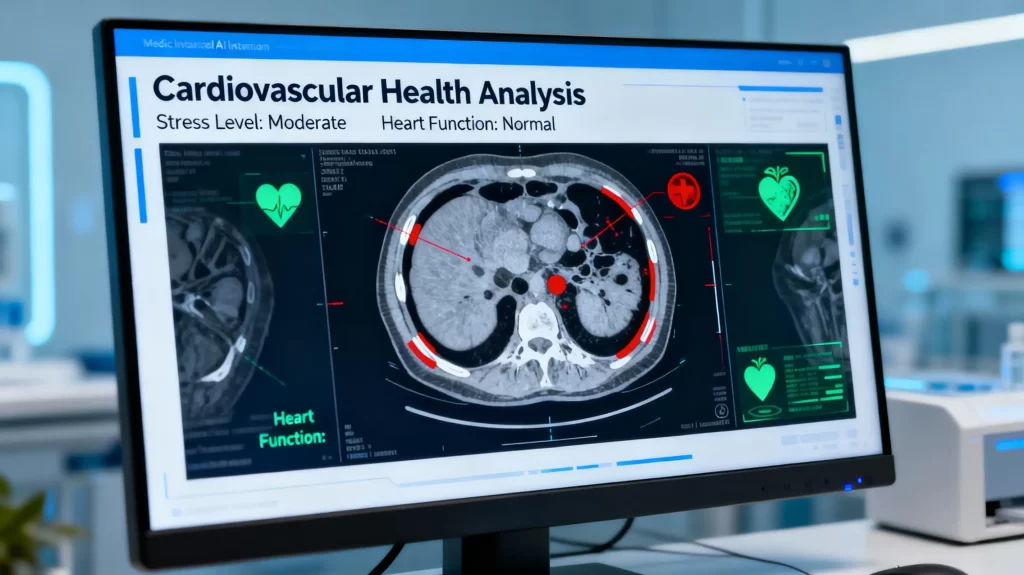
If you asked me five years ago whether stress could be pulled out of a chest CT scan using AI, I would have laughed and probably recommended better coffee. But here we are.
The health world loves dramatic headlines—new cancer cures, robot surgeons, pills that promise everything except paying your bills. But this new discovery quietly slipped under the radar while everyone was distracted screaming into voids on social media. Chronic stress. Objectively measured. Predicted from a CT scan that might have been taken because someone thought you swallowed a coin or had a cough that refused to quit.
This is not the future knocking politely on the door. It is already inside your living room eating snacks.
Researchers from Johns Hopkins have built an AI model that measures your adrenal glands on routine chest CT scans and calculates something called the Adrenal Volume Index (AVI). It turns out your adrenals can tell a long, depressing, medically useful story about how much cortisol they have been forced to pump out because your brain thinks every day is a gladiator match. And the kicker? Bigger adrenal glands = bigger chance your heart eventually gives up and files for bankruptcy.
This might sound confusing, but stick with me.
Adrenal glands: tiny organs, huge receipts
Let us get one thing straight—your adrenal glands are not just decorative kidney hats. These two small walnut-sized organs sit on top of your kidneys and handle the cortisol department. The hormone that shoots up when you are stressed, sleep-deprived, or mentally composing a resignation letter at 2 AM.
Stress itself is normal. Short bursts make sense. That is biology doing biology things. But when stress becomes your default personality setting, that same system starts going wrong in slow motion. The adrenal cortex thickens because it keeps getting screamed at to release cortisol. More ACTH signals. More cortisol. Day after day. Month after month. Eventually, the glands literally grow. It is basically work-from-home burnout immortalized into anatomy.
When I heard this, the first thing that crossed my mind was:
So you’re telling me stress leaves organ-sized evidence… like fossil records, but emotionally caused?
Exactly.
Now Johns Hopkins built AI to detect that enlargement automatically from CT images. No blood test. No new scan. No extra radiation exposure. The data is already there. Hospitals take millions of chest CT scans every year for tons of reasons, so this biomarker is like finding a hidden season of your medical life that nobody aired yet.
And it predicts outcomes up to 15 years in advance.
That is wild. Also, deeply offensive to the idea that stress is “just in your head.”
Proof that it is real and not a PowerPoint hallucination
The researchers did not just measure adrenal size on a random Tuesday and declare it genius. They validated the discovery using data from 2,842 participants of the Multi-Ethnic Study of Atherosclerosis (MESA), one of the most detailed long-term health cohorts we have. This dataset did the heavy lifting no influencer app could ever do.
MESA recorded chest CT scans where both adrenal glands were clearly visible. On top of that, participants had salivary cortisol samples taken 8 times over 2 days—not once, not twice, but basically every time cortisol felt like gossiping. They also filled out psychological stress questionnaires that measured perceived stress, anxiety, and depression. Plus, doctors tracked cardiovascular outcomes and mortality for up to 15 years.
When they compared the adrenal size data from the CT scans to everything else, the results lined up a little too clearly to be coincidence:
- Higher AVI correlated with higher salivary cortisol levels across the day.
- It predicted allostatic load (fancy term for your body wearing down because stress is doing overtime).
- People with larger adrenal volume scored higher on anxiety and depression assessments.
- And most important: AVI remained predictive even after factoring in traditional risk variables like smoking, blood pressure, cholesterol, etc.
This means cortisol-induced adrenal enlargement is not riding shotgun in heart disease. It is holding the steering wheel.
Researchers calculated that:
Each 1 cm³/m² increase in AVI is tied to about a 4.4% higher risk for heart failure, and about 4.5% higher risk of premature death from any cause.
You might be wondering how bad “high stress” looks compared to average. According to their models, jumping from average population stress to high population stress equated to roughly a 35% higher relative risk of heart failure later in life.
So yeah, stress is now officially a load-bearing biological foundation, not optional emotional DLC.
Why the heart cares about cortisol
Let me be honest—your heart is patient, but it is not immortal. When cortisol stays chronically elevated, it flips multiple switches that were not built to stay on forever.
Here’s the thing: the biggest damage from stress does not come from the adrenal glands themselves. They are just the reporters. The real chaos unfolds downstream in systems your body assumed would run quietly while you lived an uncomplicated life in a forest or whatever we were designed for.
- Cortisol messes with metabolism first.
- Next, cortisol messes with blood pressure.
- Then, inflammation kicks in.
- Autonomic nervous system regulation gets stuck.
- Finally, cardiac remodeling starts.
Eventually, heart failure becomes mathematically unavoidable.
So yeah. That is why adrenal size turned out to be such a good chronic stress proxy. It is not just hormone production. It is accumulated biological pressure that reshapes the system over decades.
Who carries the heaviest invisible load
Chronic stress does not get shared equally in the population. Some people get a manageable subscription. Others are on the premium, lifetime family plan nobody asked for.
Research already shows that structural racism, financial instability, unsafe neighborhoods, job insecurity, and inaccessible healthcare create sustained activation of the HPA axis. And those populations historically show higher heart failure risk and premature mortality. The adrenal scan method finally gives a tool to quantify that instead of hand-waving at statistics and hoping someone funds a solution.
This imaging biomarker has the potential to:
- Highlight high-stress communities for targeted preventive interventions.
- Provide measurable proof for the biological impact of social determinants.
- Push public health planning toward precision stress tracking, not vague advice.
- Quantify inequity in terms that force policy conversations to take notes instead of pretending to care.
That said, this will only work if the model gets tested across different hospital systems and scanner types, because medical tech consistency is often held together by hope and duct tape.
Regulatory reality check: when can doctors use this
Right now, the AVI AI discovery was presented at RSNA 2025 (November), but it is not published yet. After publication, they would likely file a 510(k) submission to the FDA since it is an imaging analysis tool that does not add new radiation or procedure risk.
Most realistic timeline to clinical availability:
18–24 months from now (mid-to-late 2027) if regulatory review is expedited and commercialization begins immediately at academic centers.
Could it take longer? Sure. Medical systems move slower than a tired browser tab. But even with delays, we are still on the verge of catscanning cortisol damage like it is a second diagnosis layer on imaging you would have had anyway.
Other tech quietly building the stress surveillance suite
This is not standalone magic either. Other cortisol tracking tech emerging in 2025 includes:
- Portable Lab-on-a-Chip cortisol saliva testers from the University of Cincinnati.
- Oral wearables like smart dentures or braces that continuously sample saliva to read cortisol.
HRV wearables + cortisol oral sampling + AVI imaging eventually become a multi-mode stress detection loop that sees current spikes, long-term accumulation, and system-wide physiological damage signals.
And honestly? I am relieved. We needed receipts.
The real meaning of this
Stress medicine has been hand-wavy forever. Doctors would say stress is hurting while having no real way to measure chronic exposure or predict outcomes objectively. Now we have an imaging biomarker, measured by AI, that turns invisible stress into a number and links it to one of the biggest killers on Earth: heart failure.
This is huge. But it is huge the way foundational stuff is huge—not flashy, just medically undeniable.
It gives doctors a tool that says: chronic stress is physically measurable, predictive, and clinically relevant. It personalizes prevention. It quantifies inequity biologically. It shifts cardiology from reaction mode to early prediction and intensive prevention.
If you feel like stress is reshaping your body, well, surprise, it literally is. But now we can actually see it. Measure it. And do something before the heart throws a 404 forever.
Check Our Courses : Data Science Classroom Training, Python Classroom Training, Machine Learning Course , Deep Learning Course , AI-Deep Learning using TensorFlow , AI Full Stack Online Course , Cyber Security Course in Bangalore , Core Ai Training , Digital Marketing Training , Power BI Training in Bangalore , React Js Training , Devops Training in Bengalore , Microsoft sql Training .