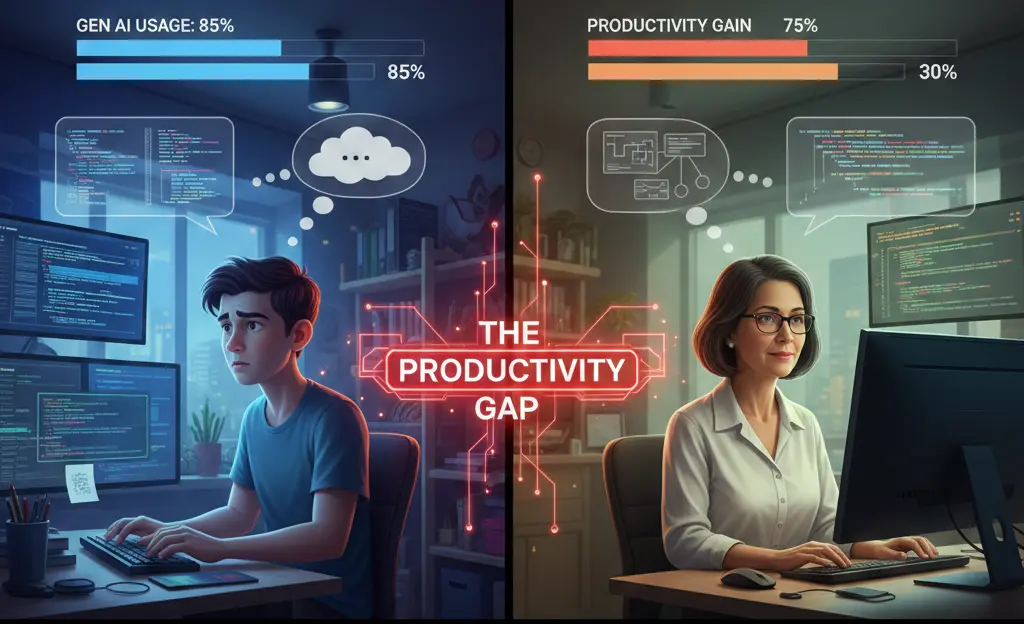
Generative AI is everywhere in software development right now. You can not open Twitter, LinkedIn, or a dev subreddit without someone saying AI is changing everything. And to be fair, it kind of is. A huge chunk of code written today comes from AI-assisted tools. That part is real.
But here is the thing. A recent study shows something uncomfortable that no one really wants to talk about. The people using AI the most are not the ones benefiting the most from it. In fact, it is almost the opposite.
This article originally came from reporting around a study shared by ZDNET and later circulated through MSN. I went through the findings and, honestly, it explains a lot of what many developers are quietly experiencing but not saying out loud.
There is a productivity gap forming. And it mostly splits junior and senior developers.
AI Adoption Is Exploding, No Debate There
Let us start with the obvious part. Generative AI adoption in software development is not slow, experimental, or niche anymore. It is aggressive. In just two years, the share of AI-generated code jumped from about 5 percent to nearly 30 percent by the end of 2024. That is not a trend. That is a shift.
This means almost one out of every three lines of code today has some AI involvement. That alone should make you pause.
Now here is where it gets interesting. Junior developers are leading this adoption. Roughly 37 percent of their code involves AI assistance. That makes sense on paper. If you are newer, AI feels like a safety net. It answers questions fast, writes boilerplate instantly, and does not judge you.
So far, so good.
But productivity gains do not follow the same pattern.
More AI Use Does Not Automatically Mean More Output
The study measured overall productivity increases and found an average boost of around 4 percent. That might not sound massive, but across large engineering teams, it adds up fast.
The catch is where those gains show up.
They are concentrated almost entirely among experienced developers.
Junior developers, despite using AI more frequently, are not seeing the same output improvements. They are not expanding into new technical areas as much. They are not compounding speed over time. In some cases, they are just spinning their wheels faster.
This might sound confusing at first. If AI writes code, why does experience still matter so much?
The answer is uncomfortable but simple. AI does not replace understanding. It amplifies it.
The Difference Is Not the Tool, It Is the Way It Is Used
Senior developers tend to treat AI like a junior assistant. They review everything. They question suggestions. They modify outputs aggressively. They use AI across a wide range of tasks, from architecture exploration to debugging edge cases.
Junior developers often treat AI like a vending machine. Prompt goes in, code comes out, ship it.
That difference matters more than people realize.
When an experienced developer sees AI-generated code, they instantly notice what is missing. Error handling. Performance concerns. Security issues. Architectural mismatches. A junior developer may not even know those questions exist yet.
So the AI saves time for seniors. For juniors, it sometimes creates extra work later.
Speed Feels Good, but Value Is What Counts
There is also a trap here. Speed feels productive. Finishing tickets faster feels productive. But speed alone is not value.
Senior developers use AI to remove low-value work. Scaffolding, boilerplate, repetitive documentation. That frees up mental space for design decisions, system thinking, and problem-solving.
Junior developers often end up babysitting AI output. Debugging weird errors. Trying to understand why something does not work. Copying fixes without really learning why they work.
To be honest, this is not entirely their fault. AI tools market themselves as shortcuts. And when you are early in your career, shortcuts are tempting.
But shortcuts without understanding do not compound. They stall.
Exploration Is Where Seniors Pull Ahead
One of the most interesting findings from the study is about exploration. Experienced developers use AI to step into unfamiliar technical territory. New libraries. New frameworks. New architectural patterns.
AI acts like a bridge. It lowers the friction of trying something new.
Junior developers use AI more narrowly. Mostly to complete known tasks faster. Less experimentation. Less architectural curiosity. Less risk-taking.
This is ironic, because AI could actually be a powerful learning tool for juniors if used differently. But without a strong foundation, exploration feels risky instead of exciting.
The Role of the Developer Is Quietly Changing
There is a bigger shift happening underneath all of this. The developer role itself is moving away from pure syntax writing.
The highest-value developers are becoming system orchestrators. They think in flows, dependencies, trade-offs, and long-term impact. AI fits perfectly into that role as a force multiplier.
If your job is still mostly typing code line by line, AI will eventually feel threatening. If your job is designing systems, AI feels like leverage.
This is why simply handing out AI subscriptions to everyone does not magically improve team performance. Without training, context, and expectations, it can actually widen skill gaps.
What Junior Developers Should Actually Do Instead
If you are early in your career, the takeaway is not to stop using AI. That would be stupid. The takeaway is to stop using it blindly.
You need fundamentals. Not because fundamentals are romantic or traditional, but because you cannot review what you do not understand. AI output without validation is just guesswork with better grammar.
Focus on reading the code AI gives you. Break it. Modify it. Ask why it chose one approach over another. Use AI to explain unfamiliar concepts, not just to finish tasks faster.
Here is the thing most people will not tell you. AI will not replace junior developers. But juniors who never build real understanding will struggle to grow into seniors.
The Bottom Line No One Likes
AI is not a cheat code. It is a multiplier.
If your base skill level is low, AI multiplies confusion. If your base skill level is high, AI multiplies impact.
That is the productivity gap in plain terms.
Generative AI is not leveling the playing field. It is quietly reshaping it. And experience still matters more than any tool, prompt, or subscription.
Check Our Courses : Data Science Classroom Training, Python Classroom Training, Machine Learning Course , Deep Learning Course , AI-Deep Learning using TensorFlow , AI Full Stack Online Course , Cyber Security Course in Bangalore , Core Ai Training , Digital Marketing Training , Power BI Training in Bangalore , React Js Training , Devops Training in Bengalore , Microsoft sql Training .