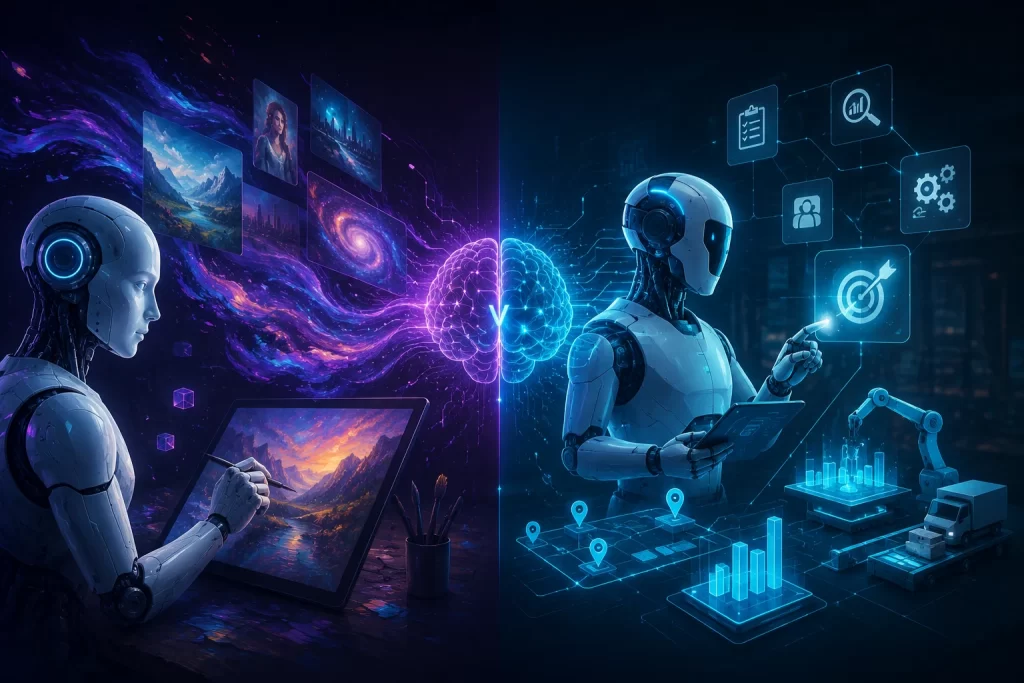
Artificial Intelligence is evolving rapidly, and two technologies gaining significant attention in 2026 are Generative AI and Agentic AI. While both are transforming how businesses and developers use artificial intelligence, they serve different purposes.
Generative AI primarily creates content such as text, images, code, audio, and video based on user instructions. Agentic AI goes a step further by understanding goals, planning tasks, making decisions, using tools, and taking actions with limited human intervention.
Understanding the difference between Generative AI and Agentic AI is becoming increasingly important for students, developers, data professionals, and anyone planning to build a career in AI.
What Is Generative AI?
Generative AI is a type of artificial intelligence that can create new content based on patterns learned from large datasets.
Unlike traditional AI systems that mainly analyze or classify existing information, Generative AI can produce new outputs based on a user’s prompt.
For example, a Generative AI system can:
- Write articles and emails
- Generate computer code
- Create images
- Summarize documents
- Generate presentations
- Create marketing content
- Answer questions
- Translate languages
- Generate audio and video
Popular Generative AI applications include AI chatbots, coding assistants, image-generation tools, and content-generation platforms.
How Does Generative AI Work?
Generative AI models are trained on large amounts of data. They learn patterns, relationships, language structures, and other characteristics from the training data.
When a user provides a prompt, the model processes the instruction and generates an appropriate response.
For example:
User:
“Write a Python program to calculate the average of five numbers.”
Generative AI:
The system generates the Python code based on the user’s request.
The AI creates the output, but the user generally decides what to do with that output.
What Is Agentic AI?
Agentic AI refers to AI systems designed to work toward a goal by planning tasks, reasoning through problems, using tools, making decisions, and taking actions.
Instead of simply responding to a prompt, an AI agent can determine what steps are necessary to complete a task.
For example, imagine a user says:
“Find the best flight options for my business trip, compare prices, check my calendar, and prepare the itinerary.”
A traditional Generative AI system may provide suggestions or information.
An Agentic AI system could potentially:
- Understand the objective
- Break the task into smaller steps
- Search for relevant information
- Compare available options
- Check connected tools or systems
- Make decisions based on predefined criteria
- Complete the required actions
- Report the result to the user
This ability to plan and act toward a goal is one of the major differences between Generative AI and Agentic AI.
Generative AI vs Agentic AI: Key Difference
The simplest way to understand the difference is:
Generative AI creates. Agentic AI acts.
Generative AI is mainly focused on producing an output from a prompt.
Agentic AI focuses on achieving an objective by deciding what actions need to be performed.
For example:
Generative AI:
“Write an email to a customer about a delayed order.”
Agentic AI:
“Identify delayed orders, check the order status, determine the reason for the delay, draft an appropriate email, and send it after approval.”
The second example involves multiple steps, decision-making, and actions.
Generative AI vs Agentic AI: Comparison
| Feature | Generative AI | Agentic AI |
| Primary purpose | Generate content | Achieve goals and complete tasks |
| Main capability | Content generation | Planning, reasoning and action |
| Input | Prompt or instruction | Goal or objective |
| Output | Text, image, code, audio, etc. | Actions, decisions and completed tasks |
| Decision-making | Usually limited | More autonomous |
| Tool usage | May use tools when integrated | Designed to use tools and systems |
| Task execution | Usually user-driven | Can execute multi-step workflows |
| Human involvement | Generally higher | Can be lower depending on system design |
| Examples | Content generation, coding, summarization | Workflow automation, research agents, task automation |
| Complexity | Relatively simpler | Usually more complex |
How Does Agentic AI Work?
Agentic AI systems can combine multiple technologies to complete a goal.
A typical Agentic AI workflow may include:
Goal → Planning → Reasoning → Tool Usage → Action → Evaluation → Final Result
1. Goal Understanding
The system first understands what the user wants to accomplish.
2. Task Planning
The AI breaks the larger objective into smaller tasks.
3. Reasoning
The system determines which steps should be performed and in what order.
4. Tool Usage
The agent may interact with external tools, APIs, databases, search systems, applications, or other software.
5. Action
The system performs the required tasks.
6. Evaluation
The agent can evaluate the results and determine whether additional steps are required.
7. Completion
Once the objective is achieved, the agent provides the result to the user.
This makes Agentic AI particularly useful for complex, multi-step workflows.
Examples of Generative AI
Generative AI is already being used across many industries.
Content Creation
Businesses can use Generative AI to create:
- Blog articles
- Social media posts
- Product descriptions
- Email drafts
- Advertisements
Software Development
Developers can use AI to:
- Generate code
- Explain code
- Find potential bugs
- Create test cases
- Generate documentation
Education
Students and educators can use Generative AI for:
- Learning explanations
- Study materials
- Summaries
- Practice questions
- Personalized learning assistance
Design and Media
Generative AI can help create:
- Images
- Videos
- Presentations
- Voice content
- Creative concepts
Examples of Agentic AI
Agentic AI has applications where completing a task requires multiple decisions or actions.
Customer Support
An AI agent can potentially:
- Understand a customer’s problem
- Retrieve account information
- Check previous interactions
- Identify the appropriate solution
- Create a support ticket
- Escalate the issue when necessary
Software Development
An AI development agent can assist with workflows such as:
- Understanding a development requirement
- Creating code
- Running tests
- Identifying errors
- Modifying the code
- Re-running tests
- Preparing a final solution
Business Automation
Agents can help automate workflows such as:
- Data collection
- Report generation
- Lead qualification
- Document processing
- Internal research
- Workflow management
Research
An AI agent can potentially:
- Understand a research question
- Search multiple sources
- Collect relevant information
- Analyze the findings
- Organize the information
- Generate a report
Is Agentic AI the Same as Generative AI?
No. Agentic AI and Generative AI are not the same, but they can work together.
Generative AI can act as the intelligence responsible for understanding language, generating content, or reasoning about information within an agentic system.
An Agentic AI application can combine:
- Large Language Models (LLMs)
- Generative AI
- Retrieval-Augmented Generation (RAG)
- APIs
- External tools
- Databases
- Memory
- Planning mechanisms
- Workflow orchestration
Therefore, Agentic AI can be viewed as a broader system that uses AI models and tools to accomplish goals.
Generative AI vs Agentic AI: Which Should You Learn in 2026?
The answer depends on your career goals.
If you are new to AI, Generative AI is a good starting point because it helps you understand:
- Large Language Models
- Prompt engineering
- AI applications
- Embeddings
- RAG
- AI APIs
- AI application development
Once you understand these concepts, you can progress toward building more advanced Agentic AI systems.
If you are a developer or technology professional, learning both can be highly valuable.
A possible learning path is:
Python → Machine Learning Basics → Generative AI → LLMs → Prompt Engineering → RAG → LangChain → AI Agents → Agentic AI Applications
Skills Required for Generative AI
To build Generative AI applications, you can learn:
- Python
- Machine Learning fundamentals
- Deep Learning basics
- Large Language Models
- Prompt Engineering
- Embeddings
- Vector Databases
- RAG
- LangChain or similar frameworks
- AI APIs
- Model evaluation
- Deployment
Skills Required for Agentic AI
Agentic AI development requires many of the same foundational skills, along with additional knowledge of autonomous workflows.
Important areas include:
- Python
- Generative AI
- LLMs
- Prompt Engineering
- RAG
- APIs
- Tool calling
- Function calling
- AI agents
- Workflow orchestration
- Memory
- Multi-agent systems
- Evaluation and monitoring
- Cloud platforms
Developers should also understand how to design systems that are reliable, secure, controllable, and capable of handling failures.
Career Opportunities in Generative AI and Agentic AI
The growth of AI is creating new opportunities for professionals with practical AI development skills.
Potential career paths include:
- Generative AI Developer
- AI Engineer
- Machine Learning Engineer
- AI Application Developer
- LLM Engineer
- AI Agent Developer
- AI Solutions Architect
- Machine Learning Developer
- Data Scientist
- AI Automation Engineer
For students and freshers, building practical projects can be an important way to demonstrate AI skills to potential employers.
Future of Generative AI and Agentic AI
Generative AI and Agentic AI are likely to become increasingly connected.
Generative AI provides powerful capabilities for understanding and generating information, while Agentic AI can use those capabilities to perform more complex workflows.
In the future, businesses may increasingly use AI systems that can:
- Understand business objectives
- Analyze information
- Make recommendations
- Interact with software
- Automate repetitive workflows
- Collaborate with humans
- Work with other AI agents
However, greater autonomy also creates challenges related to security, privacy, reliability, cost, human oversight, and responsible AI.
For this reason, learning how to build and manage AI systems responsibly will be just as important as learning how to build them.
Frequently Asked Questions
What is the difference between Generative AI and Agentic AI?
Generative AI primarily creates content such as text, images, code, audio, or video. Agentic AI is designed to work toward a goal by planning tasks, using tools, making decisions, and taking actions.
Is Agentic AI better than Generative AI?
Neither is universally better. They solve different problems. Generative AI is highly useful for content creation and information generation, while Agentic AI is useful for complex, multi-step tasks and workflow automation.
Is ChatGPT Generative AI or Agentic AI?
ChatGPT is fundamentally a Generative AI system, although AI assistants can also incorporate agentic capabilities such as tool use, planning, and task execution.
Should I learn Generative AI before Agentic AI?
For most beginners, learning Generative AI and LLM fundamentals first provides a strong foundation before moving into Agentic AI.
Is Agentic AI a good career option in 2026?
Agentic AI is an emerging area with growing interest because businesses are exploring AI systems capable of automating complex workflows. Professionals with strong foundations in software development, Generative AI, LLMs, APIs, and AI agents can prepare for opportunities in this area.
What should I learn to become an Agentic AI developer?
Start with Python and AI fundamentals, then learn Generative AI, LLMs, RAG, APIs, tool calling, AI agents, LangChain or similar frameworks, workflow orchestration, and practical AI application development.
Conclusion
Generative AI and Agentic AI represent two important directions in the evolution of artificial intelligence.
Generative AI focuses primarily on creating content and generating responses, while Agentic AI focuses on understanding goals, planning tasks, making decisions, using tools, and taking actions.
For anyone planning an AI career in 2026, learning only how to use AI tools may not be enough. Building a strong foundation in Python, Generative AI, LLMs, RAG, AI agents, and practical AI application development can help you prepare for the next generation of AI technologies.
If you’re looking to build practical skills in Generative AI, Agentic AI, RAG, LangChain, and AI application development, NearLearn offers industry-oriented AI training designed to help learners move from fundamentals to real-world projects.