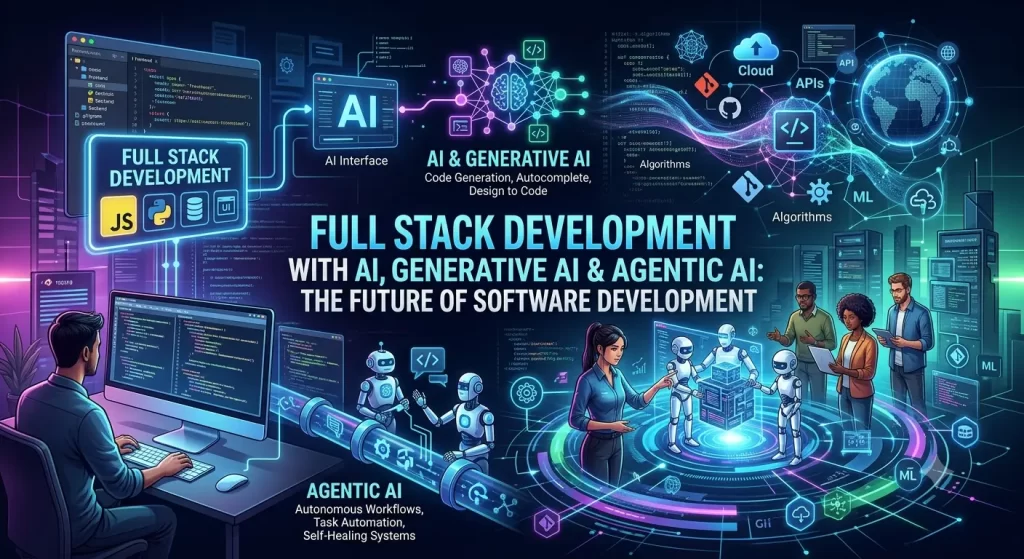
Software development is rapidly evolving with the growth of Artificial Intelligence (AI), Generative AI (GenAI), and Agentic AI. Traditional full stack development focuses on building the frontend, backend, databases, APIs, and deployment infrastructure of applications. Today, developers can combine these skills with AI technologies to create smarter and more automated applications.
Full Stack Development with AI brings together software development and modern AI capabilities, allowing developers to build applications that can understand natural language, generate content, analyze information, and automate specific tasks.
For students and professionals planning to build a career in modern software development, learning Full Stack Development, AI, Generative AI, LLMs, RAG, and Agentic AI can provide a strong technology foundation.
What Is Full Stack Development?
Full stack development involves working on both the frontend and backend of an application.
A full stack developer typically works with:
- HTML, CSS and JavaScript
- React and other frontend frameworks
- Backend technologies such as Python, Java or Node.js
- SQL and NoSQL databases
- REST APIs
- Authentication and security
- Git and GitHub
- Cloud and deployment technologies
These fundamentals are important because AI-powered applications still require a complete software architecture.
For example, an AI application may have a React frontend, a Python or Node.js backend, a database, and an AI model connected through an API.
How AI Is Changing Full Stack Development
AI is becoming an important part of both the development process and the applications developers build.
Developers can use AI for:
- Code generation
- Debugging
- Testing
- Documentation
- Data analysis
- Content generation
- Personalization
- Search
- Recommendation systems
- Workflow automation
More importantly, developers can integrate AI directly into applications using AI APIs, machine learning models, LLMs and specialized frameworks.
This has created demand for developers who understand both software engineering and AI application development.
What Is Generative AI?
Generative AI is a type of artificial intelligence that can generate new content based on prompts and available context.
It can be used to generate:
- Text
- Code
- Summaries
- Conversations
- Images
- Structured information
Generative AI applications commonly use Large Language Models (LLMs).
Full stack developers can integrate Generative AI into applications such as:
- AI chatbots
- Customer support assistants
- AI content tools
- Coding assistants
- Document analysis applications
- Personalized learning platforms
LLMs and RAG in AI Applications
Large Language Models (LLMs) are central to many Generative AI applications. Developers can connect LLMs to web applications through APIs and build customized AI experiences.
Another important technology is Retrieval-Augmented Generation (RAG).
RAG allows an AI application to retrieve relevant information from an external knowledge source and use that information to generate a response.
A simplified RAG workflow is:
User Question → Retrieve Relevant Information → LLM → Generate Response
RAG can be used for:
- Document question-answering
- Company knowledge assistants
- Educational applications
- Customer support
- Internal search systems
This makes RAG an important concept for developers building AI-powered applications.
What Is Agentic AI?
Agentic AI goes beyond simply generating a response. Agentic systems can be designed to complete tasks through multiple steps and interact with defined tools or systems.
An AI agent may:
- Understand a user request
- Break the request into tasks
- Retrieve relevant information
- Use available tools
- Perform actions
- Evaluate the results
- Continue the workflow when appropriate
For example, an AI-powered business application could receive a request, retrieve information from a database, process the information, generate a report, and return the result to the user.
This creates new possibilities for AI-powered automation and intelligent applications.
Full Stack + GenAI + Agentic AI
Combining these technologies allows developers to build complete AI-powered applications.
Consider an AI Customer Support Application:
Frontend: React interface where customers submit questions.
Backend: Manages authentication, business logic and API requests.
Database: Stores application and customer information.
Generative AI: Generates natural-language responses.
RAG: Retrieves relevant information from company documents.
Agentic AI: Coordinates authorized multi-step tasks using defined tools.
This shows how traditional full stack development can provide the foundation for modern AI applications.
Skills to Learn for AI Full Stack Development
A developer interested in this field can build skills across several areas.
Full Stack Development
- HTML & CSS
- JavaScript
- React
- Backend development
- APIs
- Databases
- Git & GitHub
AI & Generative AI
- Python
- AI fundamentals
- Machine Learning basics
- LLMs
- Prompt Engineering
- AI APIs
- Embeddings
- RAG
- Vector databases
Agentic AI
- AI Agents
- Tool calling
- Function calling
- Multi-step workflows
- AI automation
- Agent orchestration
Deployment
- Docker
- Cloud platforms
- Application security
- Monitoring and deployment
Projects to Build
Hands-on projects can help learners understand how these technologies work together.
Some project ideas include:
- AI Chatbot: Build a chatbot using an LLM API.
- RAG Document Assistant: Upload documents and ask questions about their content.
- AI Resume Analyzer: Create an application that analyzes resumes and generates structured insights.
- AI Customer Support System: Combine an LLM with a knowledge base.
- AI Task Automation Agent: Build an agent capable of completing defined multi-step tasks.
These projects can help demonstrate practical skills in both full stack development and AI.
Career Opportunities
Learning full stack development along with AI technologies can lead to various technology roles, including:
- Full Stack Developer
- AI Full Stack Developer
- AI Application Developer
- Generative AI Developer
- AI Engineer
- Machine Learning Engineer
- Backend Developer
- Software Developer
The specific skills required depend on the role and organization.
Conclusion
The combination of Full Stack Development, AI, Generative AI and Agentic AI is creating new ways to build modern software applications.
Developers can start with strong full stack fundamentals and then expand into Python, Machine Learning, LLMs, RAG, Generative AI, AI Agents and Agentic AI.
Most importantly, learning should go beyond theory. Building practical projects helps developers understand how frontend, backend, databases, APIs and AI technologies work together.
Build Your AI Development Skills with NearLearn
NearLearn offers training in AI, Data Science, Generative AI, Agentic AI, AI Agents, LLMs, RAG, Machine Learning, Python and AI Full Stack Development, helping learners develop practical and industry-relevant technology skills.
Check Our Courses : Data Science Classroom Training, Python Classroom Training, Machine Learning Course , Deep Learning Course , AI-Deep Learning using TensorFlow , AI Full Stack Online Course , Cyber Security Course in Bangalore , Core Ai Training , Digital Marketing Training , Power BI Training in Bangalore , React Js Training , Devops Training in Bengalore , Microsoft sql Training .