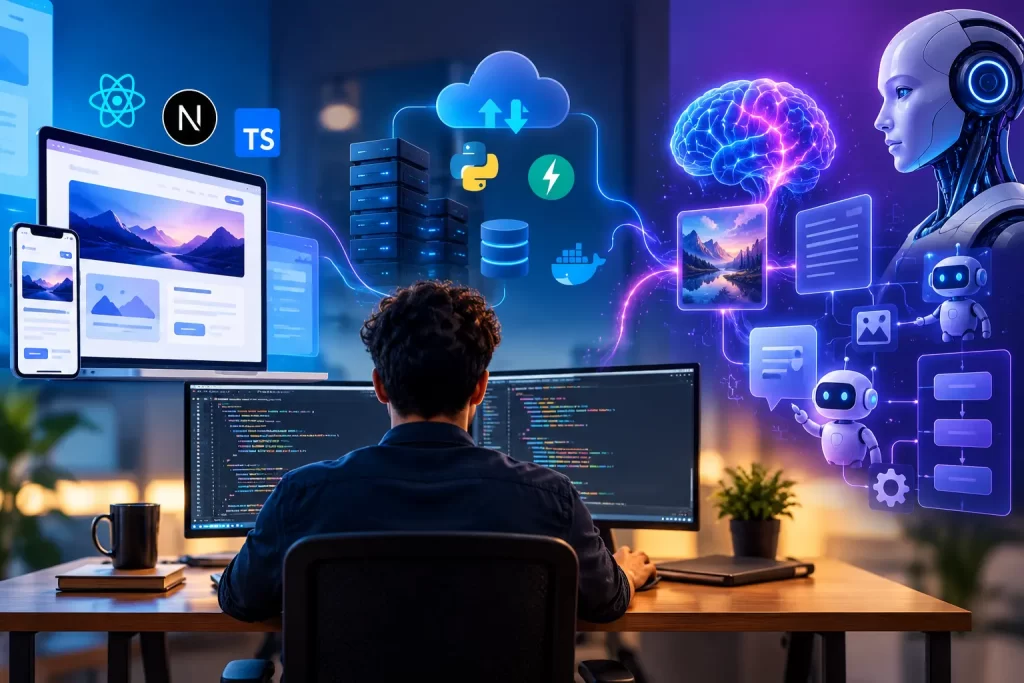
Software development is evolving rapidly with the growth of Artificial Intelligence (AI), Generative AI (GenAI), and Agentic AI. Traditional full stack developers build the frontend, backend, databases, APIs, and deployment infrastructure of applications. Today, these skills can be combined with AI technologies to create intelligent, automated, and personalized applications.
This combination of Full Stack Development + AI + Generative AI + Agentic AI is becoming an important area for developers who want to build modern software solutions.
What Is Full Stack Development?
Full stack development involves building both the frontend and backend of an application. A full stack developer works across different layers of a software application, including:
- HTML, CSS and JavaScript
- React and other frontend frameworks
- Backend technologies such as Python, Java and Node.js
- SQL and NoSQL databases
- REST APIs
- Authentication and security
- Git and GitHub
- Cloud and deployment
These fundamentals remain important even when AI is added to an application. AI-powered applications still require a well-designed frontend, backend, database, APIs, and secure infrastructure.
How AI Is Transforming Full Stack Development
AI is changing both how applications are developed and what applications can do.
Developers can use AI for code generation, debugging, testing, documentation, data analysis, content creation, recommendations, and automation.
At the application level, developers can integrate AI models through APIs to create features such as intelligent chatbots, recommendation systems, AI search, document analysis, and personalized user experiences.
This has created a growing need for developers who understand both software development and AI technologies.
Generative AI and Full Stack Development
Generative AI refers to AI systems that can generate new content based on user prompts and available context. It can generate text, code, summaries, conversations, images, and other types of content.
Full stack developers can integrate Generative AI into applications to build:
- AI chatbots
- Content generation tools
- Coding assistants
- Document summarization systems
- Customer support assistants
- AI-powered search
- Personalized applications
For example, a React-based frontend can collect a user’s prompt, while the backend communicates with an LLM through an API and returns the generated response to the application.
The Role of LLMs and RAG
Large Language Models (LLMs) are an important component of many Generative AI applications. Developers can connect LLMs to applications through APIs and build customized AI experiences.
Another important technology is Retrieval-Augmented Generation (RAG).
RAG allows an AI application to retrieve relevant information from an external knowledge source before generating a response.
A typical workflow is:
User Question → Retrieve Relevant Information → LLM → Generated Response
RAG can be used for document assistants, company knowledge bases, educational applications, customer support systems, and internal search.
What Is Agentic AI?
While Generative AI can generate responses and content, Agentic AI focuses on completing tasks through multiple steps.
An AI agent can be designed to understand a request, determine the required steps, use available tools, retrieve information, and perform authorized actions.
For example, an AI business assistant could receive a request, retrieve information from a database, analyze it, prepare a report, and return the result to the user.
Agentic AI therefore introduces another layer of capability to full stack applications by enabling more complex AI-powered workflows and automation.
How Full Stack, GenAI and Agentic AI Work Together
Consider an AI-powered customer support application:
Frontend: React interface for customers and support teams.
Backend: Handles authentication, business logic, APIs, and application workflows.
Database: Stores customer and application information.
Generative AI: Generates natural-language responses.
RAG: Retrieves relevant information from company documents.
Agentic AI: Coordinates defined multi-step tasks using available tools.
This combination allows developers to build applications that go beyond traditional websites and web applications.
Skills to Learn for AI Full Stack Development
If you want to build AI-powered applications, focus on these areas:
Full Stack Development
- HTML and CSS
- JavaScript
- React
- Backend development
- REST APIs
- Databases
- Git and GitHub
AI & Generative AI
- Python
- Machine Learning fundamentals
- LLMs
- Prompt Engineering
- AI APIs
- Embeddings
- RAG
- Vector databases
Agentic AI
- AI Agents
- Tool calling
- Function calling
- Multi-step workflows
- AI automation
- Agent orchestration
Deployment
- Docker
- Cloud platforms
- Security fundamentals
- Application monitoring
Projects You Can Build
Hands-on projects are one of the best ways to understand how these technologies work together.
Some useful project ideas include:
- AI Chatbot using an LLM API
- RAG Document Assistant for asking questions about uploaded documents
- AI Resume Analyzer for extracting and analyzing candidate information
- AI Customer Support Platform using LLMs and a knowledge base
- AI Task Automation Agent for completing defined multi-step workflows
These projects allow learners to practice frontend development, backend development, APIs, databases, and AI integration in one application.
Career Opportunities
Developing skills across full stack development and AI can prepare learners for roles such as:
- Full Stack Developer
- AI Full Stack Developer
- AI Application Developer
- Generative AI Developer
- AI Engineer
- Machine Learning Engineer
- Backend Developer
- Software Developer
The required skills vary depending on the organization and role.
Conclusion
The combination of Full Stack Development, AI, Generative AI, LLMs, RAG, and Agentic AI is creating new possibilities for software development.
A strong learning path starts with full stack fundamentals and gradually adds Python, AI, Generative AI, LLMs, RAG, AI Agents, and Agentic AI.
Most importantly, learners should focus on practical projects rather than theory alone. Building complete AI-powered applications helps developers understand how frontend, backend, databases, APIs, and AI technologies work together.
Check Our Courses : Data Science Classroom Training, Python Classroom Training, Machine Learning Course , Deep Learning Course , AI-Deep Learning using TensorFlow , AI Full Stack Online Course , Cyber Security Course in Bangalore , Core Ai Training , Digital Marketing Training , Power BI Training in Bangalore , React Js Training , Devops Training in Bengalore , Microsoft sql Training .