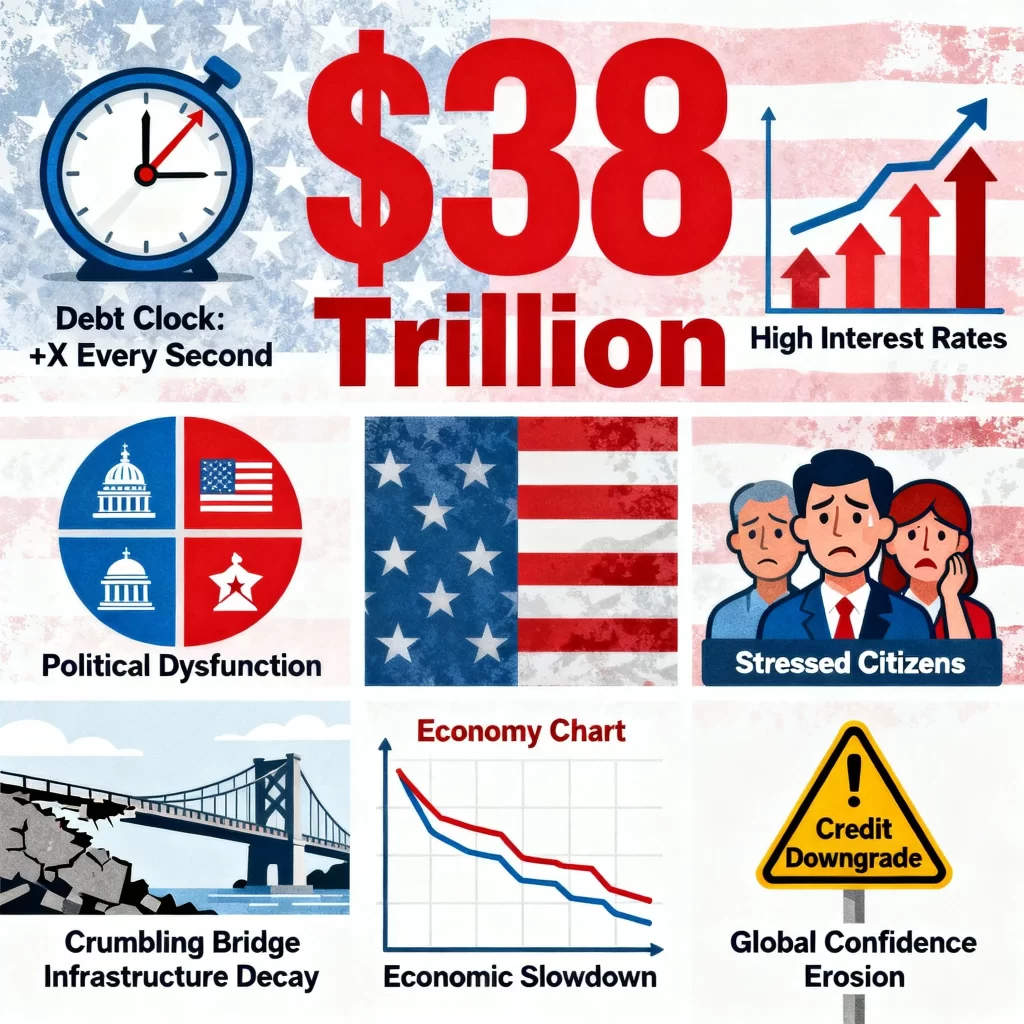
So, here we are. The U.S. just blew past $38 trillion in national debt. Yeah, trillion with a “T.” To be honest, it is kind of wild to even say that number out loud. Just ten years ago, it sounded like science fiction. Now, it is our reality — and it happened faster than almost anyone expected.
If you have been following the headlines, you might have seen that this latest milestone came only about two months after we hit $37 trillion. That is insanely fast. Outside of the pandemic years, we have never added debt at this pace before. And the worst part? It does not look like it is slowing down anytime soon.
The Numbers Are Pretty Ugly
According to the U.S. Treasury, we added a full $1 trillion in debt in roughly 60 days. That is like adding another giant government program… except it is just interest and existing obligations piling up.
The federal deficit for the last fiscal year — ending September 30, 2025 — was around $1.8 trillion. Meanwhile, interest payments on that debt are now pushing $1 trillion a year. Just the interest! That alone is starting to rival what we spend on defense or healthcare.
And this might sound confusing, but when interest payments grow that big, it traps the government. The more we owe, the more interest we pay, and the harder it becomes to pay for things we actually need. It’s like maxing out your credit cards, then realizing most of your paycheck now goes to interest, not the stuff you wanted to buy.
The Warnings Have Been There for Years
Michael A. Peterson, who runs the Peter G. Peterson Foundation (they focus on national debt issues), has basically been shouting about this for years. He said recently, “We are adding debt faster than ever… no way for a great nation to run its finances.”
And honestly, he’s not wrong. Every fiscal watchdog in D.C. is saying the same thing. The Congressional Budget Office (CBO) projects that our public debt will go from around 100% of GDP in 2025 to roughly 120% by 2035 — if we just keep doing what we’re doing. That means we’ll owe more than we make as a country every single year. Over the next decade, the CBO expects interest costs alone could hit $14 trillion, which is more than triple what we paid over the past ten years.
Let that sink in. We are spending trillions just to keep up with our past borrowing — not even for new stuff.
Why the Debt Keeps Exploding
So what is actually driving this? It is not just one thing. There are a bunch of factors feeding into this mess.
- High interest rates: The Federal Reserve has been keeping them up to fight inflation, which makes sense, but it also means the government has to pay way more just to service its existing debt. Imagine refinancing your house but suddenly the mortgage rate jumps — same idea.
- Entitlement spending: Programs like Social Security and Medicare keep growing because the Baby Boomer generation is retiring. Those costs were predictable, but we never really fixed the math behind them.
- Political dysfunction: Congress cannot seem to agree on anything. Every year we get closer to a shutdown, and no one wants to be the one to raise taxes or cut spending. So, everything just keeps rolling downhill.
- Economic uncertainty: Every time there’s a government shutdown, market dip, or policy fight, it shakes confidence and adds new costs. It is not a pretty picture.
Credit Downgrades and Market Jitters
The financial world has definitely noticed. Moody’s, one of the big credit rating agencies, actually downgraded U.S. debt recently — from AAA (the top rating) to AA1. That might sound minor, but it is a big deal. It means investors are starting to worry that the U.S. government might not be as bulletproof as it used to be when it comes to managing money responsibly.
That downgrade has real consequences. It could make borrowing more expensive for the government, which is kind of ironic — higher interest rates mean even more debt down the road. It’s a bit of a vicious cycle. Plus, it could change how global investors look at U.S. Treasury bonds, which have always been considered the safest place to park money. If that reputation slips, it could ripple across the entire global economy.
What It Means for Everyday Americans
Here’s the thing — this is not just a Washington problem. It hits all of us eventually.
When debt gets this high, it squeezes out spending on stuff that actually matters. Think about infrastructure — all those crumbling bridges and roads? Hard to fix when the budget is eaten up by interest. Or research — the U.S. used to lead in innovation because we invested heavily in science and tech. That money is drying up. Even defense spending could get tighter, right when global tensions are rising.
And long term, this kind of debt can slow down economic growth. When the government borrows too much, it competes with the private sector for money. Businesses get less access to cheap loans, investment slows down, and the whole economy feels the drag.
Can This Be Fixed?
Most economists agree there is a way out — but it’s going to hurt. It means a mix of spending cuts, tax reforms, and maybe even rethinking how entitlement programs are structured so they’re sustainable for future generations.
The problem? Politics. Nobody wants to touch the tough stuff. Everyone in Washington seems more worried about short-term wins than long-term consequences. As one analyst put it, the capital has become “numb to dysfunction.” And that feels about right.
Without serious, bipartisan cooperation — and yeah, that word “bipartisan” almost sounds outdated now — nothing is going to change. The debt will just keep climbing, and the costs will keep piling up.
The Bottom Line
Crossing $38 trillion in debt is not just another number. It is a huge, flashing warning sign that we are living way beyond our means as a country. The scary part is, most people will not feel the effects today or tomorrow. It is a slow burn. But eventually, this kind of financial weight catches up — and when it does, the options get a lot uglier.
So yeah, maybe this sounds dramatic, but it is worth paying attention. The debt problem affects everything — from job growth to healthcare to how much your next mortgage will cost. The sooner we face it, the better shot we have at fixing it before it spirals completely out of control.
At the end of the day, it is not just about numbers on a government spreadsheet. It is about the future we are leaving behind for whoever comes next. And honestly, that should bother all of us.
Check Our Courses : Data Science Classroom Training, Python Classroom Training, Machine Learning Course , Deep Learning Course , AI-Deep Learning using TensorFlow , AI Full Stack Online Course , Cyber Security Course in Bangalore , Core Ai Training , Digital Marketing Training , Power BI Training in Bangalore , React Js Training , Devops Training in Bengalore , Microsoft sql Training .