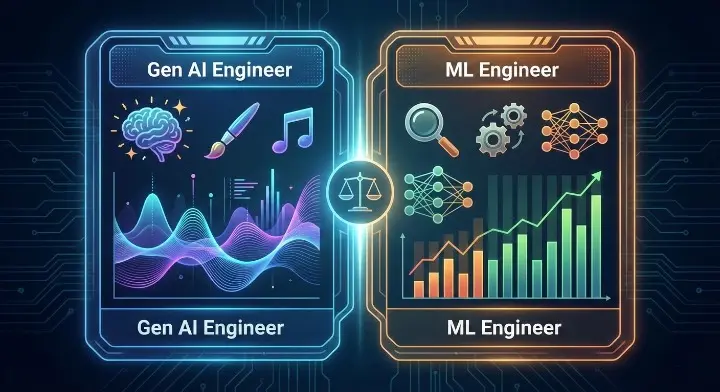
This report provides a structured comparison of GenAI engineers and ML engineers based on key aspects of their roles, responsibilities, and applications. It is designed to assist the hiring office in understanding the distinctions for recruitment, job descriptions, and talent acquisition strategies.
GenAI engineers focus on generative AI for creative content production, while ML engineers emphasize predictive analytics and decision-making systems. Both roles are critical in AI-driven industries, with growing demand but distinct skill sets and career trajectories.
Detailed Comparison
The following table summarizes the core differences across various aspects. It is derived from industry standards and the provided data, highlighting how each role aligns with organizational needs.
| Aspect | GenAI Engineer | ML Engineer |
|---|---|---|
| Main Purpose | Builds systems that generate new content (text, images, audio, code) | Builds systems that learn from data to make predictions or decisions |
| Type of AI | Generative AI | Predictive / Analytical Machine Learning |
| Primary Output | Creative outputs (chat responses, images, videos, music, code) | Predictions, classifications, recommendations, forecasts |
| Models Used | Large Language Models (LLMs), Diffusion models, Transformers | Regression models, Decision Trees, Random Forests, CNNs, RNNs |
| Data Requirement | Very large datasets, often unlabeled or semi-labeled | Structured and labeled datasets |
| Key Skills | Prompt engineering, fine-tuning LLMs, model alignment, AI safety | Feature engineering, model training, evaluation, optimization |
| Evaluation Focus | Output quality, relevance, creativity, human feedback | Accuracy, precision, recall, F1 score, RMSE |
| Engineering Style | Experimental, product-focused, fast iteration | Systematic, performance-driven, production-oriented |
| Deployment Focus | User experience, response quality, ethical safeguards | Scalability, reliability, model monitoring |
| Common Applications | Chatbots, AI assistants, content creation tools, image generation | Fraud detection, recommendation systems, demand forecasting |
| Typical Job Titles | GenAI Engineer, Prompt Engineer, AI Product Engineer | ML Engineer, Data Scientist (ML-focused) |
Key Insights
- Purpose and Output: GenAI roles prioritize innovation and creativity, ideal for user-facing products like AI-generated art or conversational bots. ML roles excel in backend analytics, supporting business intelligence and automation.
- Technical Differences: GenAI requires expertise in advanced models like LLMs (e.g., the GPT series) and handling unstructured data, whereas ML focuses on traditional algorithms and labeled data for reliability.
- Skills and Evaluation: GenAI emphasizes subjective metrics (e.g., creativity) and rapid prototyping, while ML prioritizes quantitative metrics (e.g., accuracy) and rigorous testing.
- Work Environment: GenAI is agile and iterative, suited for startups or creative teams. ML is methodical, fitting enterprise settings with high-stakes decisions.
- Applications and Demand: GenAI is booming in media and entertainment; ML is entrenched in finance, healthcare, and e-commerce. Both face ethical challenges, such as bias mitigation.
Recommendations for Hiring
- Role Definition: Clearly delineate job descriptions to avoid overlap—e.g., specify GenAI for content generation and ML for predictive modeling.
- Candidate Sourcing: Target candidates with relevant experience: GenAI from tech/art backgrounds; ML from data science or engineering fields.
- Skill Assessment: Use portfolio reviews for GenAI (e.g., demo outputs) and technical interviews/coding tests for ML (e.g., model optimization).
- Diversity and Inclusion: Both roles benefit from diverse teams to address biases in AI systems.
- Training Needs: Consider upskilling programs, as GenAI is evolving rapidly and ML requires ongoing model maintenance.
Conclusion
GenAI Engineers drive creativity and innovation through content generation and user-facing AI products, ML Engineers ensure accuracy, scalability, and data-driven decision-making across critical business systems.
Organizations should align hiring strategies with their product goals—leveraging GenAI for experience-led innovation and ML engineering for reliable, performance-oriented solutions.
Read: How To Become A Machine Learning Engineer In India
Check Our Courses : Data Science Classroom Training, Python Classroom Training, Machine Learning Course , Deep Learning Course , AI-Deep Learning using TensorFlow , AI Full Stack Online Course , Cyber Security Course in Bangalore , Core Ai Training , Digital Marketing Training , Power BI Training in Bangalore , React Js Training , Devops Training in Bengalore , Microsoft sql Training .