📊 Data Science vs. Data Analytics: What’s Actually the Difference?
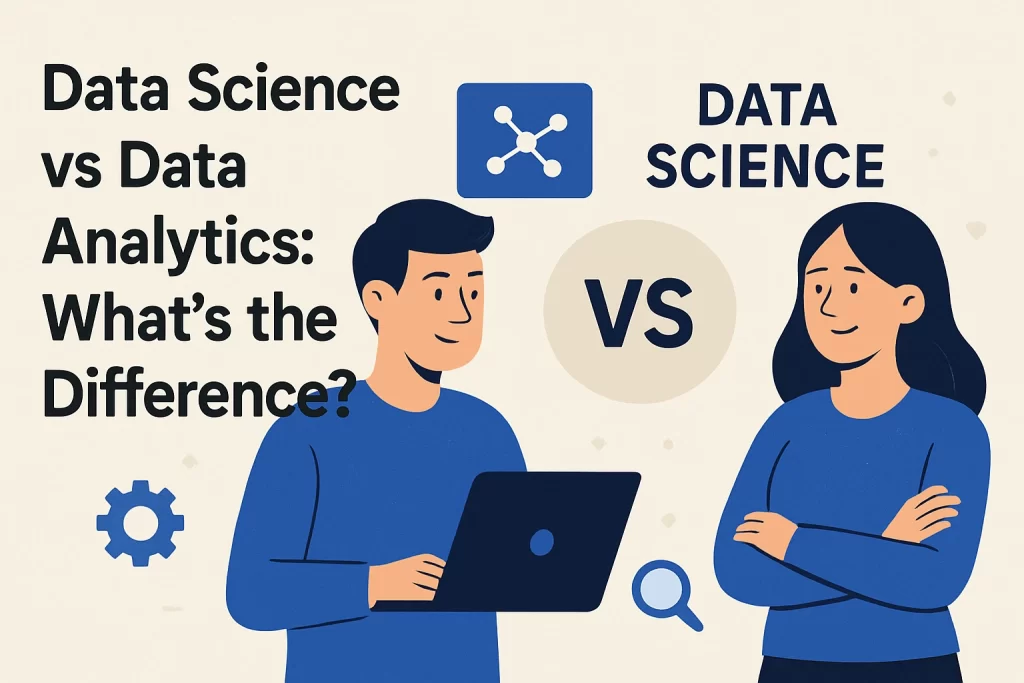
💡 Spoiler: They are not the same thing. Not even close.
So here is the deal. You have probably seen both of these terms—data science and data analytics—floating around on job boards, in tech articles, or that one friend’s LinkedIn post who just “pivoted into tech.” 🙄
And at first glance, they sound kind of… interchangeable? But nah. They are not. Sure, they both deal with data, but the stuff they actually do? Different mindset, different tools, different outcomes.
Let’s break this down like two people chatting over coffee—not like a robot giving a TED Talk. ☕📉
🧭 Different Missions: One Looks Back, the Other Looks Ahead
Here is how I think about it.
Data analytics is like doing an autopsy. You are digging through the past to figure out what happened and why. Like, “Why did sales drop last month?” or “Which ad campaign totally flopped?” The analyst pulls up the numbers, maybe builds a dashboard, and delivers the “here’s what went down” report.
Data science is more like trying to predict the future—or at least play chess with it. 🤖 You are asking, “What is going to happen next?” or even better, “Can we change what happens next?”
So yeah, analysts explain the past. Scientists try to shape the future.
🛠 The Tools: Not All Keyboards Are Used the Same
You will see some overlap in tools, for sure. Both camps love Python, SQL, maybe R if someone is feeling old school.
But analysts tend to live in stuff like Excel, Tableau, Power BI. They are slicing data, cleaning it, and then visualizing it in a way that your boss’s boss can understand at 8 AM on a Monday. 📊
Data scientists, though? They are on a whole other level with machine learning libraries like Scikit-learn, TensorFlow, or PyTorch. They are not just reporting on stuff—they are writing code that does something with that info. Predicting, automating, optimizing.
Like… you know that “You Might Also Like” section on a shopping site? That is probably not an analyst. That is a data scientist flexing some neural network. 🧠💥
❓The Kinds of Questions They Ask
Here is where it really clicks.
Data Analyst:
- What happened?
- Why did it happen?
- What does the dashboard say?
Data Scientist:
- What will happen next?
- What should we do about it?
- Can we build a system that figures that out for us?
Simple example:
- Analyst: “Website traffic dropped 25%.”
- Scientist: “Traffic’s likely to keep dropping unless we do XYZ—and here is a model that says so.”
So one is insight 📉, the other is foresight 🔮.
🧠 Skill Sets: Who Needs What?
Both need to be comfortable with data, obviously. But the depth is different.
🔍 Analysts usually:
- Know the business well
- Are solid at SQL, dashboards, and communication
- Need to translate data into something humans can act on
🧪 Scientists:
- Need to be solid in math/stats/programming
- Write code to run models, test hypotheses, handle massive data
- Might not even present to humans—they just feed models into a product pipeline
So analysts are kind of like storytellers 📚. Scientists are more like inventors ⚙.
🤖 Machine Learning: The Big Wall
If you want a clean line between the two? 🚧
It is machine learning.
That is the playground of data scientists. Models that learn, predict, and adapt on their own? That is not analytics anymore. That is science. 🧬
Analysts are usually running SQL queries and making dashboards for humans to read. Scientists are building systems that do something with that data, often without a human in the loop. Think fraud detection, recommendation engines, dynamic pricing algorithms, all that good stuff.
If someone is saying, “We are using AI to personalize your experience”—yeah, that is probably the data science team working behind the curtain. 🎩
🌍 Real-World Stuff: What Do They Actually Work On?
Let’s say you work at an e-commerce company:
🛒 The Analyst:
- Tracks revenue trends
- Measures campaign performance
- Tells you why bounce rates went up after a redesign
🤖 The Scientist:
- Builds the recommendation engine
- Designs a model to forecast next month’s sales
- Deploys a system that adjusts prices in real time
Same company, different layers of the cake 🎂.
This is true across industries:
- In healthcare: Analysts report on patient outcomes. Scientists predict who is at risk of a readmission.
- In finance: Analysts build dashboards. Scientists build real-time fraud detection models.
You need both. One gives clarity. The other gives you power.
🎓 Careers: What Fits You?
If you:
- Like telling stories with data
- Enjoy dashboards and explaining trends
- Prefer business over algorithms
👉 Analytics might be your jam.
If you:
- Like math and code
- Want to automate stuff and build predictive models
- Do not mind debugging Python scripts at 2 AM
👉 Data science is probably a better fit.
You might even start as an analyst and slowly move into science once you level up on the math and modeling side. Happens all the time. The line is blurry, and a lot of people live in between. 🔄
🧠 Final Take
Here is the honest truth:
Data science and data analytics are two halves of the same brain. 🧠
Analytics tells you what is happening right now. Science helps you figure out what could happen next—and maybe even steer it in your favor.
They are not enemies. Not even rivals. Just different seats at the same data-driven table.
So whether you are building dashboards or training neural nets, if you are working with data, you are part of the future. 💾🌍
And that is pretty damn cool.
Check Our Courses : Data Science Classroom Training, Data Science Training Course in Bangalore, Python Classroom Training.