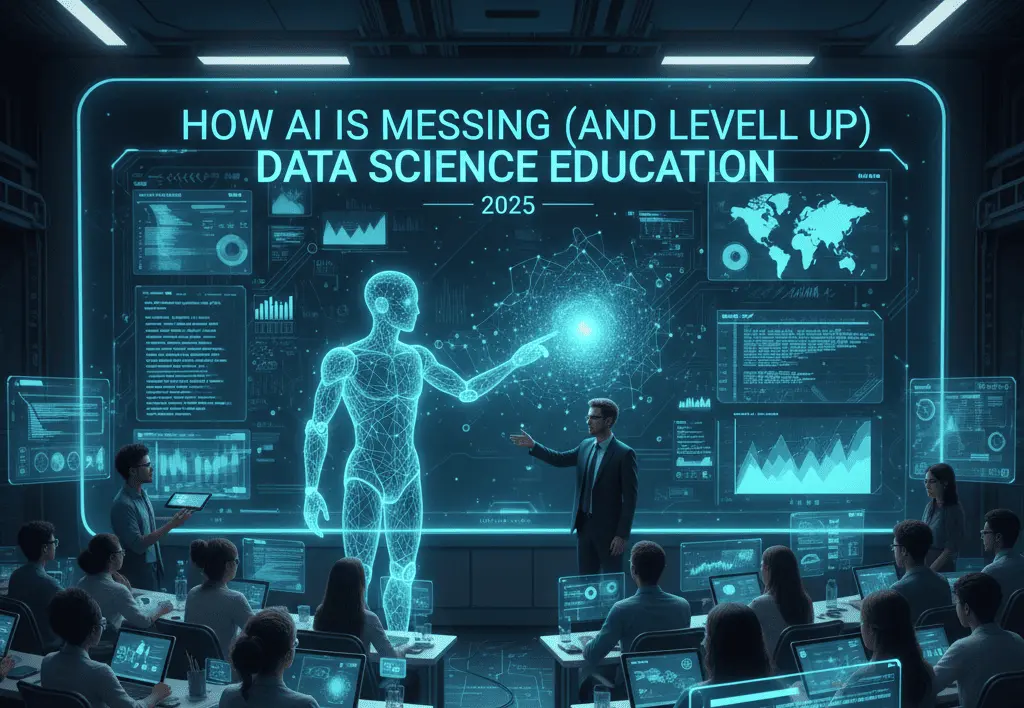
If you are learning data science right now, you probably picked the most chaotic yet exciting time to jump in. The field is changing so fast that even people already working in it are struggling to keep up. Artificial Intelligence is not just a new tool anymore — it is practically rewriting what being a “data scientist” even means.
So, if you are sitting there wondering whether all this AI hype makes learning data science pointless, here is the honest truth: it doesn’t. But you will need to learn differently than the people who started five years ago.
The Skills That Actually Matter Now
Let’s get this straight — you do not have to be a hardcore coder who dreams in Python loops anymore. AI has taken over a lot of the grunt work. Data cleaning, feature engineering, even building basic models — all that can be handled by tools like AutoML and ChatGPT-style assistants now.
But that doesn’t mean it’s easier. It’s just… different. The real challenge now is thinking. Companies don’t want people who can just write code — they want people who can figure out what problems are worth solving and how to turn insights into decisions that make money or save time.
To be honest, what matters more now are skills like:
- being able to tell a story with data,
- explaining complex stuff to people who don’t speak tech,
- understanding an industry (like healthcare, finance, or retail) beyond the surface,
- and catching when your AI model is quietly being biased or unfair.
Basically, employers are less interested in “machine learning wizards” and more in people who can use data to make smart business calls.
And just to put things in perspective — the U.S. alone has over 220,000 open data science jobs right now, and globally, the demand is more than triple the supply. AI jobs pay almost 70% more than traditional software ones. So yeah, there’s a huge opportunity — but it’s not for those stuck in old-school thinking.
From “Data Cleaner” to “Strategic Thinker”
Remember when everyone used to say data scientists spend 80% of their time cleaning data? Well, good news — that nightmare is slowly dying. AI tools now do most of that automatically.
What that means is, you finally get to focus on the parts that actually need human brains — figuring out why something happened, what it means for the business, and what to do next. You’ll be designing experiments, interpreting results, and making sure your models aren’t accidentally discriminating against people.
Think of it like this: you’re not competing against AI; you’re working with it. There was this one study — humans alone got 81% accuracy, AI alone got 73%, but together they hit 90%. That’s what the future looks like. Human + AI beats both on their own.
Data Science Is Becoming Way More Accessible
If you’ve been scared off because you thought data science was too technical, relax a little. The barrier to entry is dropping fast. Low-code and no-code tools are everywhere now. You can literally build a prediction model in a browser without touching a single line of Python if you don’t want to.
Now, before you celebrate, no — coding is not dead. You’ll still need to understand what’s happening under the hood so you don’t blindly trust AI outputs. But this shift means you can get hands-on way faster. Instead of spending months learning syntax, you can jump straight into solving problems and then learn coding naturally as you go.
And that’s the cool part. It’s no longer about memorizing libraries; it’s about understanding why something works.
Real-Time Is the New Normal
Here’s the thing — no one waits for quarterly reports anymore. Companies want answers right now. Thanks to AI analytics, data is being processed in real time, not in batches that take hours or days.
If you want to stay relevant, you’ll need to know how to work with streaming data, cloud platforms, and real-time dashboards that update on their own. That’s becoming the baseline.
The data analytics market is exploding — growing at almost 30% every year. That’s not just hype; it’s a full-on shift in how businesses operate.
Understanding Business Value = Job Security
This is one part that gets overlooked a lot. You can build the best model in the world, but if you can’t explain how it helps the business, no one cares.
AI-driven analytics are already saving companies 20–30% in operating costs and making them up to 40% more efficient. So, if you can show that your model adds real ROI — not just fancy accuracy scores — you instantly become more valuable.
Think in business terms. What does your model do for the company? Does it increase profit, reduce risk, or speed things up? That’s the kind of stuff that gets you noticed.
Ethics Is the New Superpower
This might sound boring, but honestly, it’s becoming a career-maker. AI bias and fairness are hot topics because they can wreck a company’s image faster than a bad tweet.
If an algorithm denies someone a loan unfairly or filters out certain candidates in hiring, that is not just a tech issue — it is a legal issue. So, learning how to detect bias, explain model decisions, and stay compliant with privacy laws like GDPR or CCPA is a massive plus.
The truth is, companies don’t just want data scientists anymore. They want responsible ones.
How to Learn Smarter in 2025
If you’re getting started in data science, don’t overthink it — but do it smart.
Start with the basics. Understand stats, probability, and math. Even if AI tools can automate the work, you’ll never know if they’re doing it right unless you know the fundamentals yourself.
Then, start using AI as your helper, not your crutch. Play around with coding assistants and AutoML, but always try to understand the logic behind what they’re doing.
Pick an area that actually interests you — finance, health, sports, cybersecurity — and dig into how data is used there. Having a niche gives you an edge.
And please, learn to communicate. Being able to talk about your project in simple language is half the job. Blog about your experiments, make short write-ups, or post them on GitHub. It doesn’t need to be perfect — it just needs to be real.
Lastly, build projects that mean something. Anyone can follow a tutorial, but if you can solve a real-world problem — even a small one — that’s what impresses employers.
Let’s be real — AI is not killing data science; it’s changing it. The boring stuff is being automated, freeing you up for the creative and strategic side.
By 2027, India alone is expected to have over two million AI-related job openings. That’s insane.
And the data science platform market? It’s projected to jump from about $15 billion to nearly $145 billion by 2033. If anything, this is the best time to get in.
The trick is not to fight automation — it’s to ride the wave. Learn to work with AI, focus on skills it can’t replace (like ethics, creativity, and strategic thinking), and you’ll stay ahead of the curve.
Check Our Courses : Data Science Classroom Training, Python Classroom Training, Machine Learning Course , Deep Learning Course , AI-Deep Learning using TensorFlow , AI Full Stack Online Course , Cyber Security Course in Bangalore , Core Ai Training , Digital Marketing Training , Power BI Training in Bangalore , React Js Training , Devops Training in Bengalore , Microsoft sql Training .