Let Us Be Honest: Everyone Is Talking About AI
If you spend even ten minutes on LinkedIn or tech Twitter, you will see the same thing over and over again: AI this, AI that. At some point it starts feeling like background noise.
But here is the thing. Behind all that hype, something more practical is quietly doing the heavy lifting. That thing is machine learning.
Machine learning is technically part of the AI world, sure. But it is not some shiny new toy that just appeared last year. Companies have actually been using ML for years already. It powers recommendation systems, fraud detection, spam filters, demand forecasting, and a lot of other boring but useful stuff.
In simple terms, machine learning is about training algorithms to recognize patterns in data so they can make decisions or predictions automatically. Tasks that normally required human judgment—like identifying objects in images or spotting unusual transactions—can now be handled by trained models.
By 2026, this technology is not slowing down. If anything, it is becoming more embedded in everyday business systems. Not flashy. Just everywhere.
So let us walk through a few trends that are shaping machine learning right now.
Generative AI Is Supercharging Machine Learning
You have probably heard the term generative AI a hundred times already. It is the technology that can generate text, images, code, audio, and sometimes even video.
At first it looked like a novelty. People used it to generate memes, write emails, or create random artwork.
But companies quickly realized something else. Generative AI is extremely useful when you combine it with traditional machine learning systems.
Here is a simple example.
Many companies already use ML-powered chatbots to handle customer service questions. Those bots rely on trained models that classify questions and retrieve answers.
Now add generative AI on top of that.
Instead of giving rigid scripted responses, the system can generate natural explanations, summarize information, or even write custom replies based on context.
A good example comes from the Taiwanese automaker Luxgen. They integrated generative AI into their existing machine-learning chatbot system. The result? Customer service agents reportedly saw about a 30 percent reduction in workload.
That is not magic. It is simply automation becoming more flexible.
In other words, machine learning used to follow strict instructions from its training data. Now it can improvise a little. That changes how companies design systems.
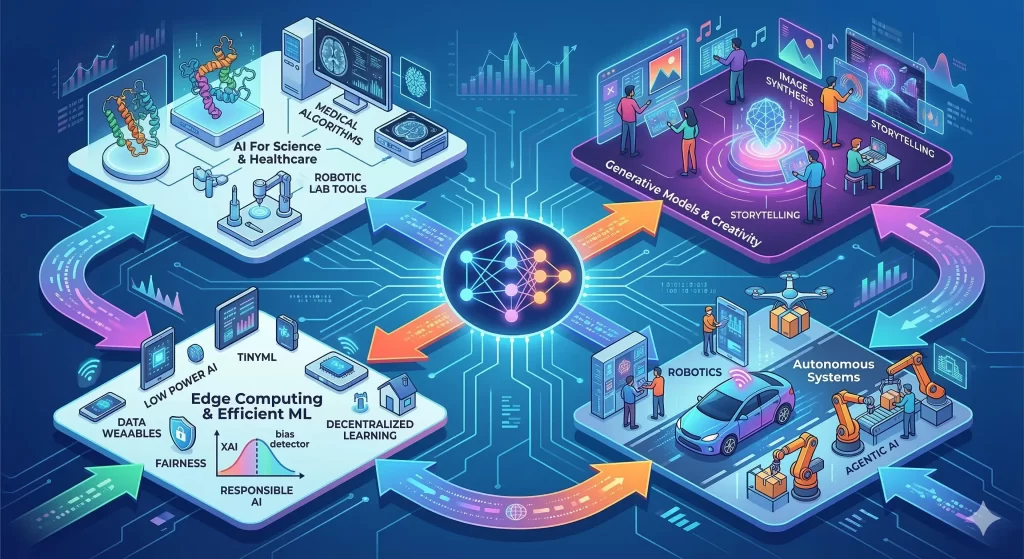
Machine Learning Is Moving Closer to Devices (Thanks to IoT)
Another interesting shift is happening with the Internet of Things, or IoT.
You might already have these devices around you without thinking about it. Security cameras. Smart speakers. Phones. Sensors in factories. Even connected appliances.
Traditionally, data from these devices was sent to the cloud, processed by ML systems there, and then results were sent back.
That works, but it creates delays. Sometimes the delay is tiny, but in many cases it matters.
Now machine learning models are starting to run directly on the devices themselves. This is often called edge AI.
What does that actually mean in practice?
Imagine a security camera analyzing footage locally instead of uploading every frame to a server. The model can detect suspicious activity instantly without waiting for cloud processing.
There are two big advantages here.
First, latency drops dramatically. The system reacts faster.
Second, privacy improves because sensitive data does not always need to leave the device.
And the scale of this ecosystem is massive. Data from IoT Analytics estimates that the number of connected devices could reach around 39 billion by 2030, growing at over 13 percent annually.
That is a ridiculous number of sensors generating data.
Machine learning is basically the only realistic way to make sense of it.
Humans and AI Are Starting to Work Together (Instead of Competing)
There is a lot of drama online about whether AI will replace humans.
You might have seen those headlines: AI will take all jobs or developers are obsolete now.
Reality is a lot less dramatic.
What we are actually seeing in many industries is collaboration, not replacement.
Take healthcare as an example.
Doctors are already using AI systems to analyze medical images like X-rays or MRIs. The algorithm highlights potential abnormalities. Then the doctor reviews the results and decides whether the finding is actually meaningful.
So the AI acts like an assistant that never gets tired.
Education is seeing similar experiments.
Some schools are testing adaptive learning tools powered by AI. These systems track how students learn and adjust lessons to match their pace.
One report about schools using these tools claimed student engagement increased by around 20 percent, while test scores improved by roughly 15 percent within a year.
Now, you might be wondering whether those numbers are universal. Probably not. Education data is messy.
But the idea itself makes sense. AI can personalize instruction in ways traditional classrooms struggle to do.
And this pattern keeps repeating across industries.
Engineers use ML models to detect anomalies in networks. Financial analysts use them to identify fraud patterns. Logistics companies use them to predict supply chain delays.
The human still makes the final call. The AI just speeds up the analysis.
I Actually Asked an AI What It Thinks
This might sound slightly ridiculous, but I tried something out of curiosity.
I opened an AI assistant on my computer and asked a simple question:
“What do you think about companies using machine learning in 2026?”
The response was pretty straightforward.
It basically said machine learning will become deeply integrated into business operations. Companies will use it to optimize processes, personalize services, improve products, and reduce costs.
It also pointed out something important: ML is no longer limited to tech companies.
Manufacturing, agriculture, healthcare, logistics, finance, retail… all of them are using it now.
And honestly, that answer is not wrong.
Machine learning has quietly moved from experimental labs into everyday infrastructure.
The Ethical Side That Companies Cannot Ignore
Now here is the less glamorous part of the conversation.
As machine learning spreads everywhere, ethical issues start showing up.
Data privacy is a big one. ML systems rely heavily on data, and that data often includes sensitive information.
Bias is another problem.
If a training dataset contains bias, the model will learn that bias. It does not magically fix itself.
So companies need governance around how these systems are built and deployed.
That usually means having dedicated teams responsible for AI oversight, data handling policies, and model auditing.
Without that structure, things can go wrong fast.
Where Machine Learning Is Headed Next
Looking ahead, machine learning in 2026 will likely become faster, cheaper, and easier to deploy.
Cloud platforms already provide pre-trained models that companies can integrate with minimal effort. Edge computing allows models to run directly on devices. Generative AI makes interaction with ML systems more flexible.
Put all of that together and you get something interesting.
Machine learning stops feeling like a special technology project.
It just becomes part of the infrastructure.
Almost like electricity in a building. You do not think about it much, but everything depends on it.
And that is probably the biggest trend of all.
AI is not some distant future anymore. It is already embedded in the systems we use every day.
Check Our Courses : Data Science Classroom Training, Python Classroom Training, Machine Learning Course , Deep Learning Course , AI-Deep Learning using TensorFlow , AI Full Stack Online Course , Cyber Security Course in Bangalore , Core Ai Training , Digital Marketing Training , Power BI Training in Bangalore , React Js Training , Devops Training in Bengalore , Microsoft sql Training .