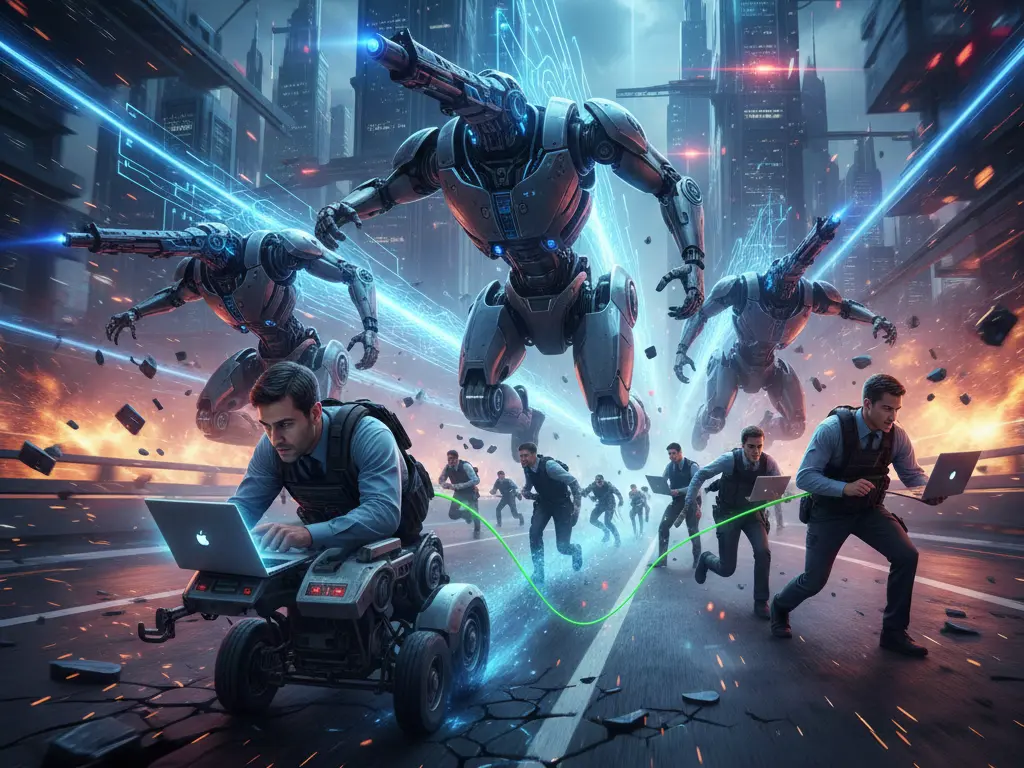
Let us get one thing straight before going any further. AI in cybersecurity is not some upcoming trend you can plan for next year. It is already baked into how attacks are happening right now. If your security stack still assumes attackers are mostly human-driven, slow, and noisy, then you are defending yesterday’s internet.
That sounds dramatic, but it is true.
The uncomfortable reality is that attackers adopted AI faster than defenders did. Not because they are smarter, but because they move faster and have fewer rules to follow. While security teams argue about budgets and approvals, threat actors just grab whatever works and ship attacks at scale.
This is not theory. This is already happening.
AI Did Not “Enhance” Attacks — It Removed the Skill Barrier
There is a common belief that AI-powered attacks are only something big enterprises or governments need to worry about. That belief is outdated.
The barrier to entry collapsed.
You no longer need to write malware from scratch, understand exploit development, or even be particularly technical. AI-driven tools on underground markets already handle that part. They generate phishing emails that actually sound human. They rewrite malware on the fly. They adapt when something fails.
This is the part people underestimate. AI did not just make attacks stronger. It made them easier.
So now the threat is not just elite hackers. It is average attackers operating with above-average tooling. And that is a nasty combination.
Why Traditional Defenses Are Struggling (And It Is Not Your Team’s Fault)
Most security stacks were built around pattern recognition. Known malware signatures. Known indicators. Known bad behavior.
AI-driven attacks do not behave that way.
Modern malware changes itself constantly. Phishing emails are generated dynamically using public information about your company, your projects, even your employees. Deepfake audio can sound exactly like your CFO asking for an urgent transfer.
If your defense relies on “we have seen this before,” then you are already behind. Because attackers are intentionally making sure you have not seen it before.
That does not mean your tools are useless. It means the assumptions behind them need updating.
What AI-Powered Attacks Actually Look Like in Practice
Let us make this less abstract.
Polymorphic malware does not arrive with a fixed fingerprint. Every version looks slightly different. Signature-based antivirus sees each one as something new. From its point of view, nothing matches.
Phishing is no longer mass spam. It is personalized, contextual, and boring in the worst way. The email does not scream “scam.” It references real work. Real names. Real deadlines. That is why people fall for it.
Deepfake attacks are not sci-fi anymore. Audio alone is enough. One convincing phone call at the wrong moment can bypass years of security training.
And then there is automated vulnerability exploitation. AI systems now scan, prioritize, and exploit faster than most patch cycles can keep up with. What used to take weeks can happen in hours.
None of this requires magic. Just scale.
Why AI Is Also the Only Real Defense That Scales
Here is the part that feels ironic but unavoidable: the same thing breaking traditional security is also the only thing that can fix it.
Humans cannot monitor everything in real time. They cannot correlate millions of signals across networks, users, and devices without help. And they definitely cannot respond fast enough when attacks move at machine speed.
AI-based defense systems are not about replacing humans. They are about filtering reality into something humans can actually act on.
Behavior-based detection matters more than signatures now. Systems that understand what “normal” looks like can spot when something quietly goes wrong, even if it has never happened before.
Automated response matters too. Not full autonomy, but fast containment. Isolate the machine. Kill the session. Lock the account. Seconds matter.
Agentic AI Is the Shift Most Teams Are Underestimating
One of the biggest changes happening quietly is agentic AI. These are systems that do not just alert, but act.
They investigate anomalies. They correlate events. They take predefined actions while humans stay in the loop. Think less “AI tool” and more “junior analyst who never sleeps.”
This is not about letting AI run wild. It is about removing the bottlenecks that attackers already removed on their side.
If your incident response still depends entirely on humans manually triaging alerts, you are fighting automation with coffee.
Why Explainability Actually Matters in Security (Not Just Compliance)
Security teams do not trust black boxes. And they should not.
If an AI flags an incident but cannot explain why, the team hesitates. That hesitation costs time. Explainable AI is not about ethics slides. It is about operational trust.
When analysts understand why a system raised an alert, they learn. Over time, the team gets sharper, not lazier. The AI becomes a training partner, not a mystery oracle.
Humans Are Still the Weakest Link (And the Strongest Defense)
Here is the uncomfortable part: AI made social engineering better than technical exploits in many cases.
People still approve things. People still trust voices. People still panic under pressure.
Training cannot be static anymore. A yearly phishing test is not enough. Attacks evolve too fast. Employees need exposure to realistic, AI-generated attacks so they recognize the patterns emotionally, not just intellectually.
And reporting mistakes needs to be safe. Fear hides breaches. Speed contains them.
Deception Works Better Than Most People Expect
Honeypots sound old-school, but modern deception tech is incredibly effective. Fake assets that should never be touched are perfect early-warning systems.
If something interacts with a decoy, you know you are dealing with malicious behavior. No guessing. No ambiguity.
AI-driven attackers still make mistakes. Deception makes sure you notice them.
This Is Not a Solo Fight Anymore
Threat actors share tools, tactics, and data constantly. Defenders who isolate themselves fall behind.
Threat intelligence sharing is not charity. It is survival. Learning from someone else’s incident is far cheaper than experiencing your own.
The organizations that adapt fastest are not necessarily the biggest. They are the ones that stopped pretending this was optional.
The Bottom Line (No Sugarcoating)
AI-powered attacks are not coming. They are already normal.
If your security posture assumes human-paced threats, you are exposed. If your defense does not use AI while attackers do, that imbalance only grows.
You do not need to fix everything at once. That usually fails. But you do need to start somewhere, deliberately, now.
This is an arms race whether we like the term or not. And standing still is a decision.
Check Our Courses : Data Science Classroom Training, Python Classroom Training, Machine Learning Course , Deep Learning Course , AI-Deep Learning using TensorFlow , AI Full Stack Online Course , Cyber Security Course in Bangalore , Core Ai Training , Digital Marketing Training , Power BI Training in Bangalore , React Js Training , Devops Training in Bengalore , Microsoft sql Training .