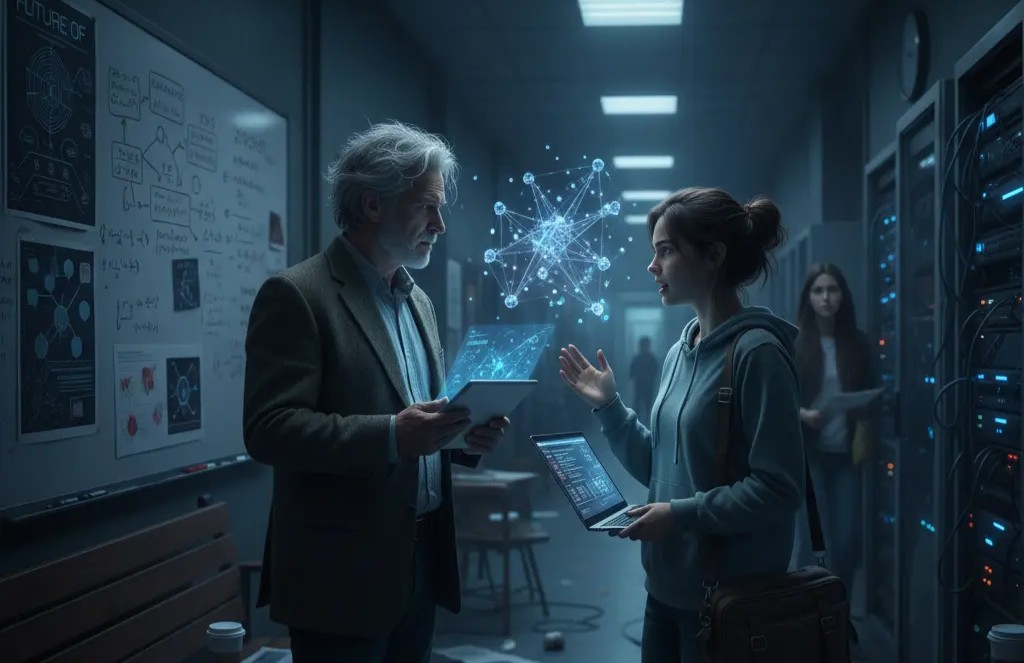
When Fei-Fei Li walked into her Princeton University office in 2007, she had no idea that her casual conversations with the linguist next door would help trigger the most significant transformation in artificial intelligence history. What began as neighborly chats between two researchers with seemingly different specialties would ultimately create the foundation for today’s AI revolution. wikipedia
The Meeting of Minds: Where Language Met Vision
Li, fresh from earning her Ph.D. in electrical engineering at Caltech, found herself in an office adjacent to Christiane Fellbaum, a seasoned linguist who had spent two decades building WordNet — an enormous database containing over 145,000 English words organized by semantic relationships. Their friendship would prove serendipitous for the future of machine learning. mbrenndoerfer
Both researchers shared what Li described as “a special interest in understanding — even mapping — the way a mind conceptualizes the world”. Fellbaum’s work on how humans organize tens of thousands of words and concepts in their brains complemented Li’s fascination with how children can recognize objects after just a single glimpse.
WordNet, originally conceived by Princeton professor George A. Miller in 1985, represented a radical departure from traditional dictionaries. Instead of alphabetical organization, it created semantic networks where related concepts connected like branches on a tree — “house” linked to “home,” “dwelling,” and “structure”. This network approach mirrored how human minds actually process and retrieve information.
From Words to Images: The Birth of ImageNet
Inspired by WordNet’s comprehensive mapping of language, Li envisioned creating a similarly ambitious project for visual recognition. Her hypothesis was revolutionary for its time: just as human children need to see many examples before recognizing objects, computer vision systems required massive datasets to achieve similar capabilities. mbrenndoerfer
Li’s timing was impeccable. In 2007, three critical elements were converging that would make her vision possible:
- Limited computing power: Machines had only 2% of today’s processing capacity
- Nascent neural networks: Deep learning algorithms weren’t widely adopted
- Small datasets: Organized training data remained scarce
Despite these constraints, Li found an unlikely champion in senior faculty member Kai Li (no relation), who understood that data storage and organization would become fundamental to AI advancement. Together with graduate student Jia Deng, they began constructing what would become “the largest hand-curated dataset in AI’s history”.
The Dataset That Changed Everything
By 2010, ImageNet contained over 14 million annotated images across 22,000 categories. Li and her team created an annual competition — the ImageNet Large Scale Visual Recognition Challenge (ILSVRC) — encouraging researchers worldwide to test their algorithms against this unprecedented dataset. viso+1
For two years, the competition produced modest improvements. Then came 2012.
A team from the University of Toronto, led by Geoffrey Hinton and his graduate students Alex Krizhevsky and Ilya Sutskever, shocked the AI community. Their model, AlexNet, used neural networks — a technique largely abandoned by the broader research community — to achieve a top-5 error rate of just 15.3%, crushing the runner-up’s 26.2% performance.
This wasn’t merely an incremental improvement; it represented what researchers now call AI’s “Big Bang moment”. The breakthrough validated Li’s core hypothesis: without massive, organized datasets, even the most sophisticated algorithms remained limited.
The Nobel Prize Connection: Foundations Meet Revolution
The 2024 Nobel Prize in Physics awarded to Geoffrey Hinton and John Hopfield underscores the deep theoretical foundations underlying this practical breakthrough. Hopfield’s 1982 invention of associative neural networks provided the mathematical framework, while Hinton’s development of the Boltzmann machine created the learning mechanisms that would eventually power AlexNet. technologyreview+3
As Hinton himself noted with characteristic humility: “Ilya thought we should do it, Alex made it work, and I got the Nobel Prize”.
This collaboration between theoretical physics and practical computer science exemplifies how breakthrough innovations emerge from interdisciplinary thinking.
The Ripple Effect: From Princeton Hallways to Global Transformation
Today, deep learning powers technologies most professionals encounter daily: smartphone facial recognition, voice assistants, recommendation algorithms, and language models like ChatGPT. The convergence of large datasets, powerful hardware, and sophisticated algorithms has created an entire industry worth hundreds of billions of dollars.
Olga Russakovsky, who worked on ImageNet as a Stanford graduate student and now serves as a Princeton computer science professor, emphasizes that the human element remains crucial. Current AI safety research increasingly asks fundamental questions about human cognition: “How is the mind actually doing this?”
Li herself continues pushing boundaries through World Labs, her 2024 startup focused on “spatial intelligence” — teaching AI systems to understand three-dimensional environments. This next frontier may prove even more challenging than the language processing revolution sparked by her ImageNet project. linkedin+1
Technical Implications for Modern Machine Learning
The ImageNet breakthrough established three foundational principles that continue driving AI advancement:
- Data-Centric Development: Li’s emphasis on comprehensive datasets over algorithmic complexity shifted industry focus toward data quality and scale. Modern foundation models follow this principle, training on increasingly massive text and image corpora. profiles.stanford+1
- Cross-Pollination Benefits: The WordNet-ImageNet connection demonstrates how insights from linguistics, cognitive science, and computer vision can create breakthrough innovations. Today’s most successful AI companies explicitly encourage interdisciplinary collaboration. mbrenndoerfer
- Benchmarking Culture: The ILSVRC competition model established systematic evaluation as an industry standard. Contemporary AI development relies heavily on standardized benchmarks for measuring progress across different domains. viso
Looking Forward: The Next Frontier
As Li noted in her 2025 discussions about spatial intelligence, the field continues evolving beyond pattern recognition toward true environmental understanding. The same collaborative spirit that sparked the ImageNet revolution — bringing together diverse expertise and ambitious vision — will likely drive the next major AI breakthrough.
The Princeton hallway conversation between Li and Fellbaum reminds us that transformational innovation often emerges from unexpected connections. In an age of increasing AI specialization, the interdisciplinary curiosity that created ImageNet remains more relevant than ever.
The question isn’t just what AI can achieve next, but which unlikely collaborations will make it possible.
Check Our Courses : Machine Learning Course , Deep Learning Course , Machine Learning Training With Python , AI-Deep Learning using TensorFlow , AI Full Stack Online Course .