Top AI Trends to Watch in 2025: The Future Is Already Here It’s easy to forget how much artificial intelligence (AI) has already changed our lives. We trust it to guide us through traffic , recommend the next show to binge, and even finish our sentences when we’re writing emails. But what’s coming next isn’t just more of the same – it’s full leap forward.
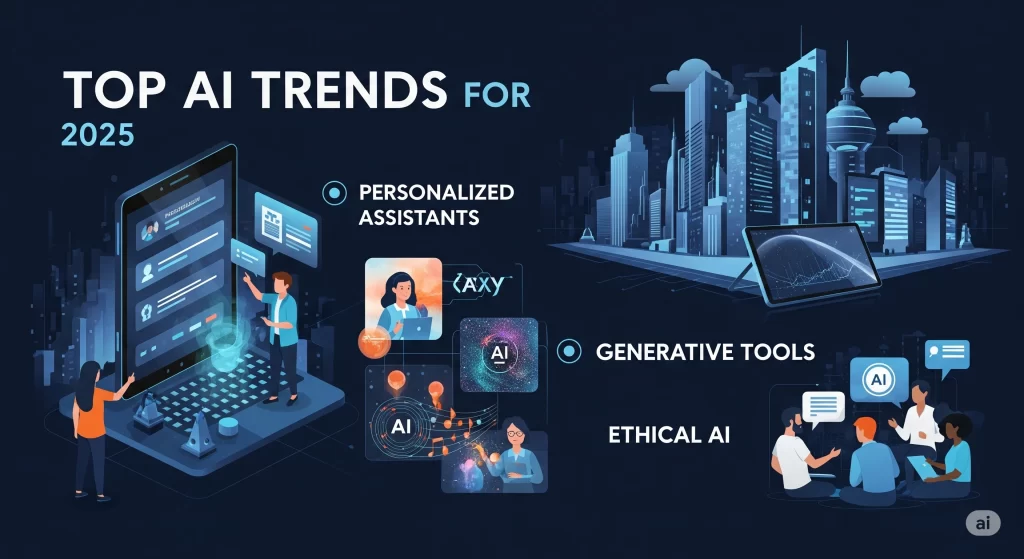
As We head into 2025, AI is moving from behind the scenes into something much more personal , proactive , and powerful. Here’s a look at the trends that are actually worth paying attention to – minus the hype.
🤖 AI Assistants That Actually Get You
Remember when Siri first came out and we were amazed she could tell us the weather?
Fast-forward to now, and most people are frustrated when these assistants still can’t understand a basic request.
That’s about to change.
By 2025, AI companions will be significantly more intuitive. They won’t just respond to commands—they’ll notice your habits, spot patterns in your stress levels, and suggest changes before you realize something’s off.
One early version I tried picked up on the fact that I got frazzled before my 3 PM meetings. It started blocking off prep time for me and even reminded me to grab a coffee. Subtle, but surprisingly helpful.
These assistants won’t just be functional—they’ll have personality. They’ll tell jokes, adapt their tone to match yours, and feel more like smart coworkers than software tools.
🌐 Generative AI for Everyone, Not Just the Pros
AI used to feel like something only coders or designers could play with. Now? Your dad can use it to make a video ad for his business, and your niece can write a story with illustrations—all in an afternoon.
In 2025, generative AI won’t just be a creative playground—it’ll be an essential part of how we work and build. Marketing teams are already using it to brainstorm 50 campaign ideas in minutes. Teachers are crafting learning games on the fly. Creators are launching businesses with AI-made art.
It’s not about AI replacing creativity—it’s about lowering the barrier so more people can create without needing advanced skills
🧠 AI That Explains Itself (Finally)
One of the most frustrating things about current AI systems? They often can’t explain why they made a decision.
You get a fraud alert on your credit card, ask why, and the response is… “The system flagged it.” Helpful.
That’s changing. In 2025, explainable AI will be a major focus—especially in areas like healthcare, finance, and law enforcement. New models are being built to show their logic step-by-step, like a math teacher walking you through a problem.
Think: “This transaction happened 3,000 miles from your usual location at 2 AM, for an unusually high amount.” Now that makes sense.
Expect regulations to start demanding this kind of clarity—because we’re no longer okay with the answer being just “because the AI said so.”
🎮 Virtual Reality Gets Real with AI
If you’ve tried VR in the past and thought, “Cool, but kind of clunky,” you’re not alone. But AI is finally unlocking the potential VR has been promising for years.
Training simulations are becoming more realistic, more responsive, and more adaptive. I recently tested one for emergency responders where the AI adjusted the scenario in real time based on how I reacted. It wasn’t just immersive—it was intense.
Gamers are seeing it too. NPCs (non-player characters) are beginning to remember what you said, how you treated them, and react accordingly. That makes the experience feel less like a game—and more like a conversation.
In 2025, expect to see AI supercharge everything from surgeon training to virtual classrooms to interactive storytelling.
🔍 Proactive AI: Solving Problems Before They Happen
The biggest leap AI is making? It’s starting to think ahead.
Your smart home doesn’t just follow routines—it starts to anticipate your needs. Mine noticed I always turn on the living room lights at 6 PM when I get home, so now it just does it automatically when I pull into the driveway.
It also warned me about an overworked HVAC system. A filter was clogged with dust from nearby construction. Fixing it early probably saved me a few hundred bucks.
Wearable health tech is getting spooky-smart too. My wife’s tracker can now alert her a couple of days before she gets sick, just by analyzing changes in her sleep and heart rate patterns. It’s not magic—it’s predictive modeling at work.
🛡 AI on the Frontlines of Cybersecurity
Cyberattacks are getting more sophisticated. So is AI.
By 2025, AI will be one of the most important tools in cybersecurity—constantly scanning for threats, learning from past attacks, and reacting in real time.
At my company, our security AI recently flagged a login attempt that looked normal on the surface—but the user’s typing and mouse movement patterns were slightly off. Turned out it wasn’t our employee. The AI caught what none of us could’ve.
But here’s the catch: attackers are using AI too. They’re creating phishing emails that look and sound exactly like internal company memos. It’s a digital arms race—and we need smarter defenses to stay one step ahead.
🌱 AI’s Role in Combating Climate Change
AI isn’t just changing tech—it’s helping save the planet.
Farmers are using AI to reduce water usage and boost crop yields. Cities are deploying it to optimize traffic lights and cut emissions. In Los Angeles, they saw a 12% drop in vehicle emissions just by letting AI handle traffic flow.
Wildfire prediction is another powerful example. AI can now analyze weather data, wind conditions, and historical fire patterns to pinpoint high-risk areas days in advance. That kind of warning can mean the difference between a spark and a catastrophe.
In 2025, you’ll see even more AI-powered solutions for sustainability—smart grids, precision agriculture, disaster planning. These tools aren’t just helpful—they’re becoming essential.
🌟 Looking Ahead: AI as a Partner, Not a Replacement
AI is no longer just about cool features or fancy tech demos. It’s becoming something deeper—something collaborative.
The most exciting shift we’ll see in 2025 is AI becoming a partner in how we think, work, and solve problems. Not just doing things for us, but working with us.
That doesn’t mean it’ll all go smoothly. There will be missteps, misuse, and stuff we don’t fully understand yet. But for once, the tech feels like it’s heading in a direction that genuinely improves lives—not just efficiency charts.
So no, your toaster won’t take over the world. But your AI might just help you live better in it.
Check Our Courses : AI Full Stack Online Course , Machine Learning Course , Ai Deep Learning Course .