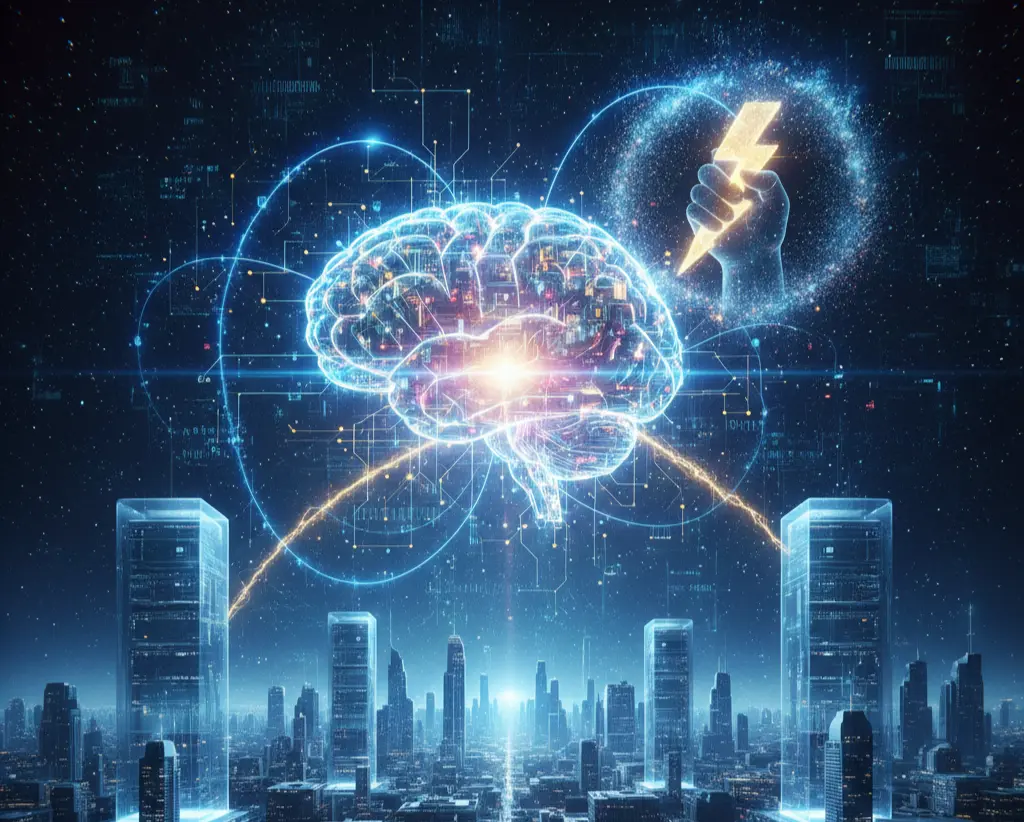
It Is Not Magic. It Is Layers of Stuff Working Together.
A lot of people talk about AI like it suddenly woke up one day and decided to become smart. That is not what happened. What actually happened is a bunch of mechanisms started interacting at scale, and the results look impressive. Sometimes almost human.
More than a billion people now use AI tools regularly. That shift really took off when ChatGPT showed up in late 2022. In just a few years, AI went from being something researchers argued about in academic papers to something your cousin uses to write emails.
So what changed?
The short answer is this: the new AI systems are powerful because multiple mechanisms interact in a way that creates emergent behavior. That phrase might sound technical, but stay with me. It just means that when you combine certain pieces, the whole system can do things that none of the pieces could do alone.
Let us break it down.
The Six Core Mechanisms Behind Modern AI
If you look at systems like OpenAI’s ChatGPT, Google’s Gemini, Anthropic’s Claude, xAI’s Grok, or Meta’s LLaMA, they all rely on similar foundations. Different branding. Same core ideas.
First, there are neural networks. Human brains use neurons connected by synapses. AI systems use mathematical structures that simulate something similar. Instead of biological cells, you have vectors and weights. Instead of a few billion neurons, you have artificial networks with trillions of parameters. It sounds abstract, but you can think of it as a giant web of adjustable connections.
Second, there is backpropagation. This is how the system learns. The model makes predictions. It gets some of them wrong. The error is pushed backward through the network, adjusting the connections slightly. Then it tries again. Over and over. That is how it improves.
Third, these systems are trained on huge amounts of data. I am talking billions of documents. Websites, articles, books, forum posts. The model learns by predicting the next word in a sequence. That might sound simple, but when you do that at scale, you start picking up patterns about language, facts, and reasoning.
Fourth, there is attention. This is not attention like a human focusing on a loud noise. In AI, attention is a mechanism that helps the model figure out which parts of the input matter more in context. If you ask a question with multiple parts, attention helps the model connect the relevant pieces. Without it, responses would feel scattered.
Fifth, reinforcement learning plays a role. Humans step in and reward better outputs. The system is nudged toward responses that are helpful, accurate, or safe. In other words, it is trained not just to predict words, but to behave in ways people prefer.
And sixth, there is hardware. This is the part most people ignore. None of this would work without specialized chips, especially GPUs from Nvidia and similar companies. These chips handle massive parallel computations. Without them, the system would be too slow to use in real time. The software gets the headlines. The hardware keeps it alive.
Why One Mechanism Alone Is Not Enough
You might be wondering, could you just take one of these pieces and get the same result?
No.
A neural network without learning is just a static structure. Learning without massive data does not scale. Attention without compute is pointless. Even powerful chips are useless without good algorithms.
The power comes from interaction.
Neural networks improve through backpropagation and reinforcement learning. Attention works alongside learning to better capture context. GPUs allow all of this to happen fast enough that millions of users can interact with the system at once.
This is what people mean by causal networks. Multiple mechanisms connect and influence each other. The result is something more complex than any single component.
Emergent Properties: The Weird Part
Here is where it gets interesting.
When these mechanisms interact, the system starts to show behaviors that do not exist in any single component. This is called emergence.
Think about water. Hydrogen and oxygen are gases. Combine them in the right structure and you get liquid water at room temperature. Neither hydrogen nor oxygen is wet on its own. Wetness emerges from the structure.
AI works in a similar way.
From neural networks, learning algorithms, attention mechanisms, reinforcement training, and specialized chips, you get things like language understanding, reasoning, and even creativity.
Modern AI can answer questions in dozens of languages. It can solve math problems, explain legal concepts, draft code, and generate stories. It can reason deductively and inductively. It can generate poems, songs, or images that did not exist before.
Does that mean it is conscious? No. It does not have sensory experience. It does not feel emotions. It does not wake up confused at 3 a.m. like humans do.
But it does approximate certain cognitive abilities in a way older systems never could.
This might sound confusing, but the key idea is simple: the intelligence is not in one part. It is in the network of interactions.
Micro and Macro: A Bigger Pattern
There is a useful way to think about this, sometimes called micro/macro emergence.
At the micro level, you have basic mechanisms. Artificial neurons. Learning rules. Attention layers. Hardware operations.
At the macro level, these combine into larger causal networks. Entire model architectures. Training pipelines. Deployment systems.
When micro mechanisms combine into macro systems, new properties emerge. Not because someone programmed “creativity” directly, but because the structure makes it possible.
This pattern shows up outside AI too.
Consciousness theories often describe small neural processes interacting to produce awareness. Diseases emerge from interactions between genes, cells, and environments. Social revolutions come from individual decisions interacting across networks of people.
In other words, AI is not special in this respect. It follows a broader pattern seen in complex systems.
So Why Does It Feel So Different Now?
To be honest, scale changed everything.
We had neural networks decades ago. We had learning algorithms. What we did not have was the combination of massive data, advanced architectures like transformers, and industrial-scale compute.
When those three aligned, the outputs crossed a threshold. The systems stopped feeling like rigid programs and started feeling conversational.
You will notice that the models still make mistakes. They hallucinate. They misinterpret context. They lack lived experience. But the gap between “tool” and “assistant” narrowed quickly.
That jump is what people are reacting to.
Final Thought
The new AI is powerful not because it contains a tiny digital mind inside it. It is powerful because multiple mechanisms interact across layers, forming causal networks that produce emergent behavior.
Neural networks. Learning. Attention. Reinforcement. Specialized chips. Massive data.
Individually, they are just parts. Together, they create systems that approximate aspects of human intelligence in ways that feel, at times, unsettlingly close.
That is not magic. It is structure plus scale.
And if history is any guide, once mechanisms start interacting at this level, we usually only see the beginning of what they can do.
Check Our Courses : Data Science Classroom Training, Python Classroom Training, Machine Learning Course , Deep Learning Course , AI-Deep Learning using TensorFlow , AI Full Stack Online Course , Cyber Security Course in Bangalore , Core Ai Training , Digital Marketing Training , Power BI Training in Bangalore , React Js Training , Devops Training in Bengalore , Microsoft sql Training .